Question
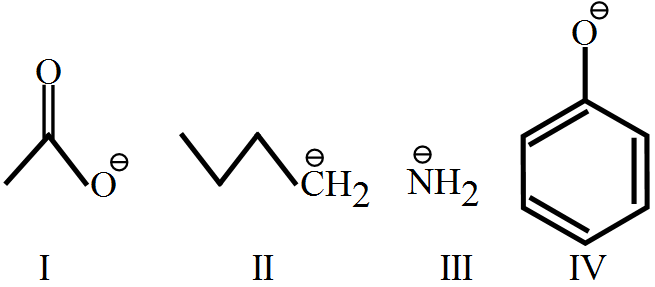
Arrange the following in increasing order of base strength:
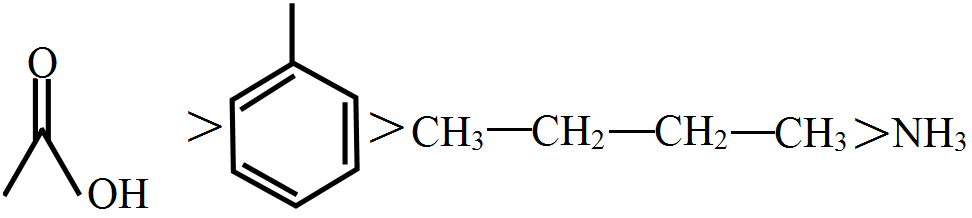
 

Answer

III > II > IV > I is increasing order of base strength because

is order of acidic character. Greater the acidic strength, weaker will be conjugate base and vice-versa.

Need a full question paper?

Generate a complete, print-ready paper with questions like this in minutes — across 16+ boards, with answer keys.

Start Generating Free

Similar questions

Why is anode called oxidation electrode, whereas cathode is called reduction electrode?
The first $(\Delta_{1}\text{H}_{1})$ and the second $(\Delta_{1}\text{H}_{1})$ionization enthalpies (in $\mathrm{kJ} \mathrm{~mol}^{-1}$ ) and the $(\Delta_{1}\text{H}_{1})$ electron gain enthalpy (in $\mathrm{kJ} \mathrm{~mol}^{-1}$ ) of a few elements are given below:
Elements $\Delta\text{H}_{1}$ $\Delta{\text{H}}_{2}$ $\Delta_{\text{eg}}\text{H}$
I 520 7300 -60
II 419 3051 -48
III 1681 3374 -328
IV 1008 1846 -295
V 2372 5251 +48
VI 738 1451 -40
Which of the above elements is likely to be:
The metal which can form a predominantly stable covalent halide of the formula MX (X=halogen)?
Which metal is present in chlorophyll? How does this metal react with $\text{N}_2$?

Complete the following:
In Rutherford’s experiment, generally the thin foil of heavy atoms, like gold, platinum etc. have been used to be bombarded by the $\alpha$-particles. If the thin foil of light atoms like aluminium etc. is used, what difference would be observed from the above results?
Justify that the following reactions are redox reactions:$4 \mathrm{BCl}_{3(\mathrm{~g})}+3 \mathrm{LiAlH}_{4(\mathrm{~s})} \rightarrow 2 \mathrm{~B}_2 \mathrm{H}_{6(\mathrm{~g})}+3 \mathrm{LiCl}_{(\mathrm{s})}+3 \mathrm{AlCl}_{3(\mathrm{~s})}$

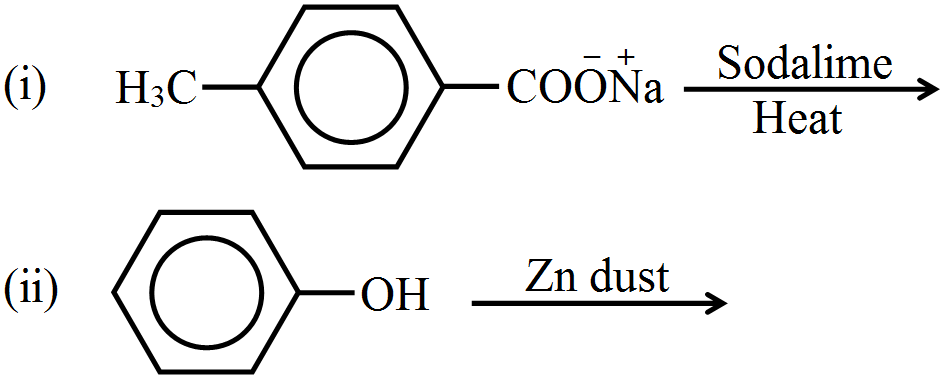
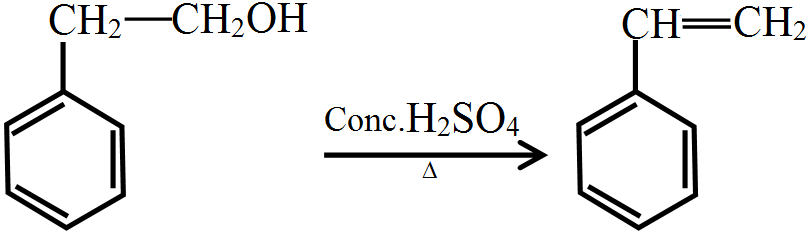
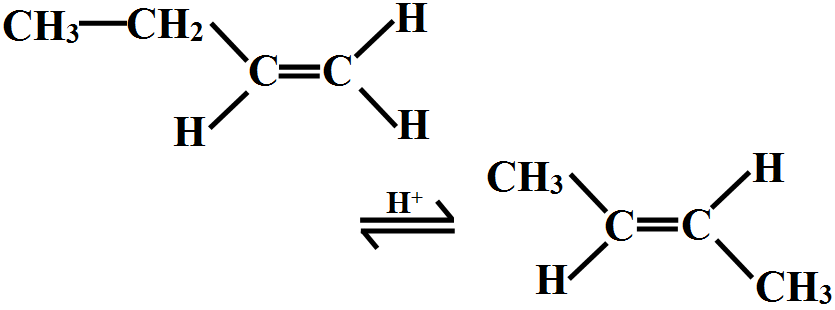
Classify the reaction type as elimination, rearrangement, addition and substitution.
  1.  
  1.  
  1. $\text{CH}_3-\text{CH(Br)}-\text{CH}(\text{CH}_3)_2\xrightarrow{\text{aq. KOH}}$
$\ \ \ \ \ \ \ \ \ \ \ \ \ \ \ \ \ \ \ \ \ \ \ \text{OH}\\\ \ \ \ \ \ \ \ \ \ \ \ \ \ \ \ \ \ \ \ \ \ \ \ \ \ |\\\text{CH}_3-\text{CH}_2-\text{C}-\text{CH}_3\\\ \ \ \ \ \ \ \ \ \ \ \ \ \ \ \ \ \ \ \ \ \ \ \ \ \ |\\\ \ \ \ \ \ \ \ \ \ \ \ \ \ \ \ \ \ \ \ \ \ \ \text{CH}_3$
Write Lewis symbols for the following atoms and ions: $S$ and $S^{2-}$.
Tea or coffee is sipped from a saucer when it is hot. Why?
Name the indicator used in redox titration involving $\mathrm{K}_2 \mathrm{Cr}_2 \mathrm{O}_7$ as an oxidising agent.