MCQ
As the mass number A increases, the binding energy per nucleon in a nucleus:
  • A
    Increases.
  • B
    Decreases.
  • C
    Remains the same.
  • Varies in a way that depends on the actual value of A.

Answer

Correct option: D.
Varies in a way that depends on the actual value of A.
Binding energy per nucleon in a nucleus first increases with increasing mass number (A) and reaches a maximum of 8.7MeV for A (50 - 80). Then, again it slowly starts decreasing with the increase in A and drops to the value of 7.5MeV.

Need a full question paper?

Generate a complete, print-ready paper with questions like this in minutes — across 16+ boards, with answer keys.
Start Generating Free

Similar questions

If a bomb is thrown at a certain angle with the horizontal and after exploding on the way the different fragments move in different directions then the centre of mass
Two masses of $1gm$ and of $4gm$ are moving with equal linear momenta. The ratio of their kinetic energies is:
The length of a metallic rod is $5m$ at $0°C$ and becomes $  5.01\, m$, on heating upto $100°C$. The linear expansion of the metal will be
A free electron is placed in the path of a plane electromagnetic wave. The electron will start moving:
A block is placed on a rough horizontal plane. A time dependent horizontal force $F = kt$ acts on the block, where $k$ is a positive constant. The acceleration - time graph of the block is
A body of mass $5\ kg$ undergoes a change in speed from $30$ to $40\ m/ s.$ Its momentum would increase by:
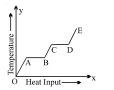
A solid material is supplied with heat at a constant rate. The temperature of material is changing with heat input as shown in the figure. What does slope $DE$ represent.
Four simple harmonic vibrations:

${y_1} = 8\,\cos\, \omega t;\,{y_2} = 4\,\cos \,\left( {\omega t + \frac{\pi }{2}} \right)$ ; 

${y_3} = 2\cos \,\left( {\omega t + \pi } \right);\,{y_4} = \,\cos \,\left( {\omega t + \frac{{3\pi }}{2}} \right)$ , 

are superposed on each other. The resulting amplitude and phase are respectively;

A body travels uniformly a distance of $ (13.8 \pm 0.2) m$ in a time $(4.0 \pm 0.3)\, s$. The velocity of the body within error limits is
In the Ingen Hauz’s experiment the wax melts up to lengths $10$ and $25 cm$ on two identical rods of different materials. The ratio of thermal conductivities of the two materials is