MCQ
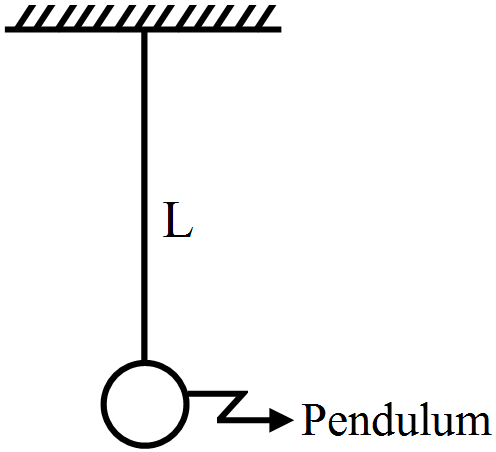
As the temperature is increased, the period of a pendulum:
  • A
    Increases as its effective length increases even though its centre of mass still remains at the centre of the bob.
  • B
    Decreases as its effective length increases even though its centre of mass still remains at the centre of the bob.
  • C
    Increases as its effective length increases due to shifting to centre of mass below the centre of the bob.
  • D
    Decreases as its effective length remains same but the centre of mass shifts above the centre of the bob.
Answer

  1. Increases as its effective length increases even though its centre of mass still remains at the centre of the bob.

Explanation:

As the temperature is increased length of the pendulum increases.

We know that, time period of pendulum $\text{T}=2\pi\sqrt{\frac{\text{L}}{\text{g}}}$

​​​​​​​$\Rightarrow\text{T}\propto\sqrt{\text{L}}$

As L, increases so, time period (T) also increases.

Need a full question paper?

Generate a complete, print-ready paper with questions like this in minutes — across 16+ boards, with answer keys.

Start Generating Free

Similar questions

Two balls of equal mass undergo head on collision while each was moving with speed $6 \,m / s$. If the coefficient of restitution is $\frac{1}{3}$, the speed of each ball after impact will be ............ $m / s$
If $\overrightarrow A \times \overrightarrow B = \overrightarrow C ,$then which of the following statements is wrong
The displacement of the wave given by equation $y ( x , t )= a \sin ( kx -\omega t +\phi)$, where $\phi=0$ at point x and $t =0$ is same as that at point
A particle moves along an arc of a circle of radius $R$ . Its velocity depends on the distance covered as $v = a\sqrt s$ , where $a$ is a constant then the angle $\alpha $ between the vector of the total acceleration and the vector of velocity as a function of $s$ will be
The ratio of total energy of all molecules of one mole $O_2$ to the total energy of all molecules of two moles of $He$ at the same temprature is
On decreasing the temperature, surface tension:
The gravitational field due to a mass distribution is $\text{I}=\frac{\text{K}}{\text{r}^3}$ in the X-direction. (K is a constant).Taking the gravitational potential to be zero at infinity, its value at a distance x is:
If a particle moves in a circle describing equal angles in equal times, its velocity vector
If body having initial velocity zero is moving with uniform acceleration $8\,\,m/{\sec ^2}$ the distance travelled by it in fifth second will be.........$metres$
The kinetic energy $k$ of a particle moving along a circle of radius $R$ depends on the distance covered $s$ as $k = as^2$ where $a$ is a constant. The force acting on the particle is