MCQ
Assertion (A) In a trapezium, the non-parallel sides are equal in length.
Reason (R) Trapezium have one pair of opposite sides that are parallel.
  • A
    Both A and R are true and R is the correct explanation of A.
  • B
    Both A and R are true but R is not the correct explanation of A.
  • C
    A is true but R is false.
  • A is false but R is true.

Answer

Correct option: D.
A is false but R is true.
D

Need a full question paper?

Generate a complete, print-ready paper with questions like this in minutes — across 16+ boards, with answer keys.

Start Generating Free

Similar questions

Assertion (A): 4 is a monomial.
Reasons (R): A monomial is an expression of the form k - xn, where k is a real number and n is a positive integer.
Assertion (A) If $x$ varies directly as $y$ and $x=80$ when $y$ is 160 , then $y=128$, when $x=64$.
Reason (R) If $x$ varies directly as $y$, then $x y=k$, where $k$ is constant.
Directions: In the following questions, the Assertions $(A)$ and Reason(s) $(R)$ have been put forward. Read both the statements carefully and choose the correct alternative from the following:
Assertion (A): Integers are commutative for division
Reason (R): Rational numbers are commutative under addition and multiplication
Assertion (A): The marked price of a book is Rs 100. The shopkeeper gives 25% discount on it. 75 is the sale price of the book.
Reasons (R): The price after the original price has been reduced by a discount is known as sale price.
Directions: In the following questions, the Assertions $(A)$ and Reason(s) $(R)$ have been put forward. Read both the statements carefully and choose the correct alternative from the following:
Assertion (A): If $x = 20$ and $y = 40$, then $x$ and $y$ are inversely proportional.
Reasons (R): A direct proportion shows the direct the relation between two quantities. An inverse proportion shows inverse or indirect relation between two quantities
Assertion (A): The smallest number by which the number 100 must be multiplied to obtain a perfect cube is 5.
Reasons (R): The perfect cube is the result of multiplying the same integer three times.
Directions: In the following questions, the Assertions $(A)$ and Reason(s) $(R)$ have been put forward. Read both the statements carefully and choose the correct alternative from the following:
Assertion (A): The common factor of $2x, 3 × 3, 4$ is $1$
Reasons (R): A common factor is a number that can be divided into two different numbers, without leaving a remainder.
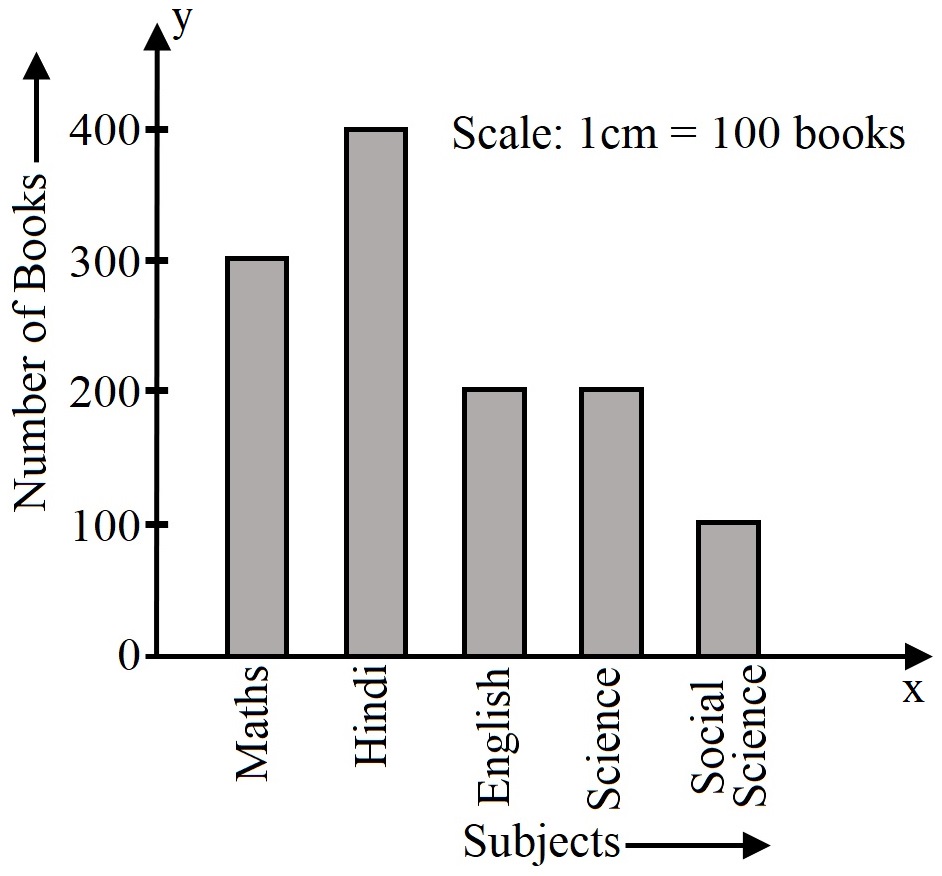
Directions: In the following questions, the Assertions $(A)$ and Reason(s) $(R)$ have been put forward. Read both the statements carefully and choose the correct alternative from the following:Observe the figure as reasons for the following assertions:

Assertion (A): The difference of the number of books of Hindi and Social Science is $300.$
Assertion (A): The smallest number by which the number 72 must be multiplied to obtain a perfect cube is 3.
Reasons (R): The perfect cube is the result of multiplying the same integer three times.
Directions: In the following questions, the Assertions $(A)$ and Reason(s) $(R)$ have been put forward. Read both the statements carefully and choose the correct alternative from the following:Observe the figure as reasons for the following assertions:
Daily Wages Number of Workers
$290-325$ $5$
$325-360$ $2$
$360-395$ $4$
$395-430$ $6$
$430-465$ $7$
$465-500$ $5$
Assertion (A): The frequency of the third class is $2.$