MCQ
Assertion (A) : The matrix $\left(\begin{array}{llll}1 & 0 & 0 & 0 \\ 0 & 2 & 0 & 0 \\ 0 & 0 & 3 & 0\end{array}\right)$ is a diagonal matrix.
Reason (R) : $A=\left(a_{i j}\right)_{m \times m}$ is a square matrix such that entry $a_{i j}=0 \forall i, j$, then $A$ is called diagonal matrix.
  • A
    Both (A) and (R) are true and (R) is the correct explanation of (A).
  • B
    Both (A) and (R) are true but (R) is not the correct explanation of (A).
  • C
    (A) is true but (R) is false.
  • (A) is false but (R) is true.

Answer

Correct option: D.
(A) is false but (R) is true.
(d) : The given matrix having order $3 \times 4$.
$\therefore \quad$ Given matrix is not a square matrix. Diagonal exist only in the square matrix.
$\therefore \quad$ Assertion is false.
On the other side, Reason satisfies the condition of diagonal matrix.
$\therefore \quad$ Assertion is false but Reason is true.

Need a full question paper?

Generate a complete, print-ready paper with questions like this in minutes — across 16+ boards, with answer keys.

Start Generating Free

Similar questions

Assertion (A) : An urn contains 5 red and 5 black balls. A ball is drawn at random, its colour is noted and is returned to the urn. Moreover, 2 additional balls of the colour drawn are put in the urn and then a ball is drawn at random. Then, the probability that the second ball is red is $\frac{1}{2}$.
Reason (R) : By Bayes' Theorem
$
\begin{array}{r}
P\left(E_1 \mid E\right)=\frac{P\left(E \mid E_1\right) P\left(E_1\right)}{P\left(E_1\right) P\left(E \mid E_1\right)+P\left(E_2\right) P\left(E \mid E_2\right)+P\left(E_3\right) P\left(E \mid E_3\right)}
\end{array}
$
Directions : In the following questions, the Assertions $(A)$ and Reason $(s) \ (R)$ have been put forward. Read both the statements carefully and choose the correct alternative from the following :
Assertion $(A) :$ There exists no tangent to the curve $=\sqrt{3\text{x}-2},$ which is parallel to the line $4x - 2y + 5 = 0$
Reason $(R) :$ Tangent to the curve $\text{x}=\sqrt{3\text{x}-2},$ exists at $\Big(\frac{41}{48},\frac{3}{4}\Big).$
Directions: In the following questions, the Assertions $(A)$ and Reason$(s) (R)$ have been put forward. Read both the statements carefully and choose the correct alternative from the following:
The equation of the tangent at $(2, 3)$ on the curve $y^2 = ax^3 + b$ is $y = 4x - 5$
Assertion $(A):$ The value of $a$ is $\pm2$
Reason $(R):$ The value of $b$ is $\pm7.$
Directions: In the following questions, the Assertions $(A)$ and Reason$(s) (R)$ have been put forward. Read both the statements carefully and choose the correct alternative from the following:
Assertion $(A): \text{f(x)}=\sin2\text{x}+3$ is defined for all real values of $x.$
Reason $(R):$ Minimum value of $\text{f(x)}$ is $2$ and Maximum value is $4.$
Directions: In the following questions, a statement of assertion $(A)$ is followed by a statement of reason $(R).$ Mark the correct choice as:
Assertion: Values of $k$ for which area of the triangle with vertices $(2, -6), (5, 4)$ and $(k, 4)$ is $\text{35 sq units}$ are $12, 2$.
Reason: Area of a triangle with vertices $A (x_1, y_1), B(x_2, y_2)$ and $C(x_3, y_3)$ is $\frac{1}{2}\begin{vmatrix}\text{x}1&\text{y}1&1\\\text{x}2&\text{y}2&1\\\text{x}3&\text{y}3&1\end{vmatrix}.$
Directions : In the following questions, a statement of assertion $(A)$ is followed by a statement of reason $(R).$ Mark the correct choice as :
Assertion : If $\text{A}=\begin{pmatrix}1 & 2 & -1\\ 2 & 0 & 3 \\ -1& 3 & 4 \end{pmatrix},$ then $A^{-1}$ is symmetric matrix.
Reason : If $A$ is symmetric matrix then $A^{-1}$ is symmetric matrix.
Assertion $(A) :$ If $(\vec{a} \times \vec{b})^2+(\vec{a} \cdot \vec{b})^2=400$ and $|\vec{a}|=4$, then $|\vec{b}|=9$.
Reason $(R) :$ If $\vec{a}$ and $\vec{b}$ are any two vectors, then $(\vec{a} \times \vec{b})^2$ is equal to $|\vec{a}|^2|\vec{b}|^2-(\vec{a} \cdot \vec{b})^2$.
Directions: In the following questions, the Assertions $(A)$ and Reason$(s) (R)$ have been put forward. Read both the statements carefully and choose the correct alternative from the following
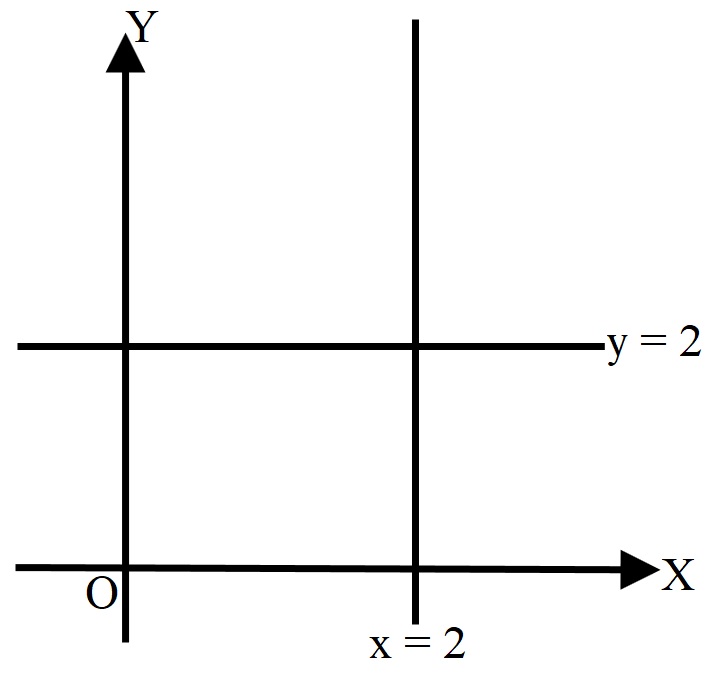
Assertion $(A):$ The graph of $\text{x}\leq2$ and $\text{y}\geq2$ will be situated in the first and second quadrants.
Reason $(R):$
Directions : In these questions, a statement of Assertion is followed by a statement of Reason is given.Choose the correct answer out of the following choices:
Assertion : Order of the differential equation whose solution is $\text{y}=\text{c}_1\text{e}^{\text{x}+\text{c}_2}+\text{c}_3\text{e}^{\text{x}+\text{c}_4}$ is $4.$
Reason : Order of the differential equation is equal to the number of independent arbitrary constants mentioned in the solution of the differential equation.
Directions: In the following questions, a statement of assertion $(A)$ is followed by a statement of reason $(R).$ Mark the correct choice as:
Assertion: A relation $R = \{(1,1), (1, 3), (3, 1), (3, 3), (3, 5)\}$ defined on the set $A = \{1, 3, 5\}$ is reflexive.
Reason: A relation $R$ on the set $A$ is transitive if $(\text{a},\text{b})\in\text{R}$ and $(\text{b},\text{c})\in\text{R}$
$\Rightarrow(\text{a},\text{c})\in\text{R}).$