MCQ
Assertion (A) : The matrix $\left(\begin{array}{llll}1 & 0 & 0 & 0 \\ 0 & 2 & 0 & 0 \\ 0 & 0 & 3 & 0\end{array}\right)$ is a diagonal matrix.
Reason (R) : $A=\left(a_{i j}\right)_{m \times m}$ is a square matrix such that entry $a_{i j}=0 \forall i, j$, then $A$ is called diagonal matrix.
  • A
    Both (A) and (R) are true and (R) is the correct explanation of (A).
  • B
    Both (A) and (R) are true but (R) is not the correct explanation of (A).
  • C
    (A) is true but (R) is false.
  • (A) is false but (R) is true.

Answer

Correct option: D.
(A) is false but (R) is true.
(d) : The given matrix having order $3 \times 4$.
$\therefore \quad$ Given matrix is not a square matrix. Diagonal exist only in the square matrix.
$\therefore \quad$ Assertion is false.
On the other side, Reason satisfies the condition of diagonal matrix.
$\therefore \quad$ Assertion is false but Reason is true.

Need a full question paper?

Generate a complete, print-ready paper with questions like this in minutes — across 16+ boards, with answer keys.

Start Generating Free

Similar questions

Assertion (A) : $x \sin x \frac{d y}{d x}+(x+x \cos x+\sin x)$ $y=\sin x, y\left(\frac{\pi}{2}\right)=1-\frac{2}{\pi} \Rightarrow y=\frac{x-\sin x}{x(1-\cos x)}$
Reason (R) : The differential equation is linear with integrating factor $x(1-\cos x)$.
Directions: In the following questions, the Assertions (A) and Reason(s) (R) have been put forward. Read both the statements carefully and choose the correct alternative from the following:
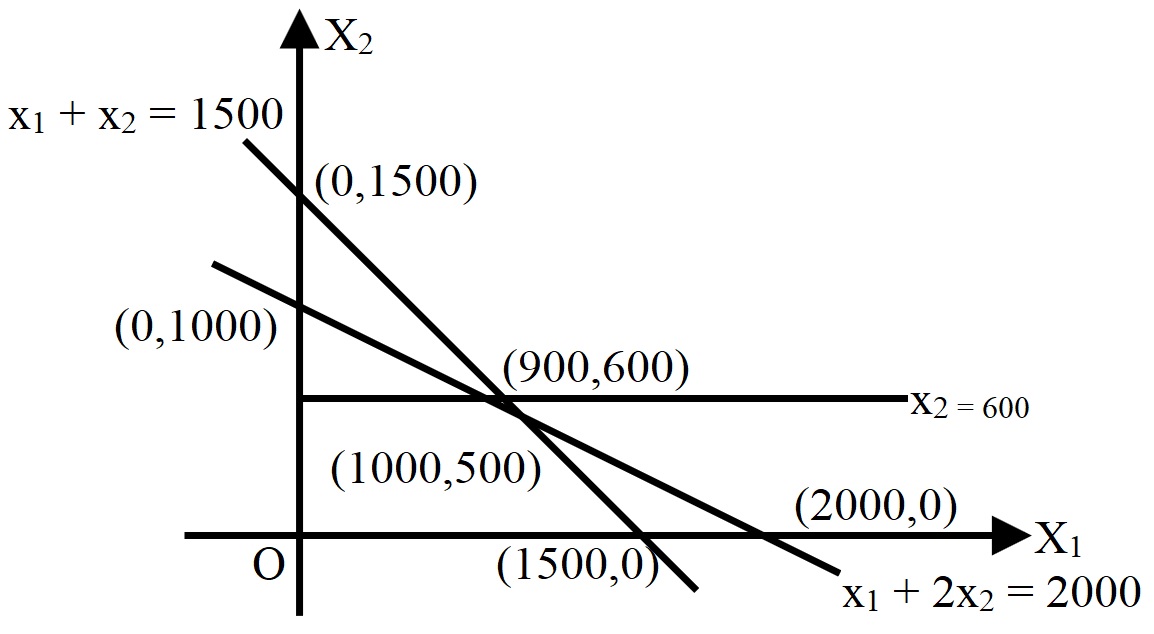
Assertion (A): For the constraints of a LPP problem given by $\text{x}_1+2\text{x}_2\leq2000,\text{x}_1+\text{x}_2\leq1500,\text{x}^2\leq600$ and $\text{x}_1,\text{x}_2\geq0$ the points (1000, 0), (0, 500), (2, 0) lie in the positive bounded region, but point (2000, 0) does not lie in the positive boundedregion.
Reason (R):

  1. Both A and R are true and R is the correct explanation of A
  2. Both A and R are true but R is NOT the correct explanation of A
  3. A is true but R is false.
  4. A is false but R is true.
Assertion (A): The area bounded by the curves $y^2=4 a^2(x-1)$ and lines $x=1$ and $y=4 a$ is $\frac{8 a}{3}$ sq. units.
Reason (R) : The area enclosed between the parabola $y^2=49 x$ and its latus rectum $\frac{8 a^2}{3}$ sq. units.
Directions: In the following questions, a statement of assertion (A) is followed by a statement of reason (R). Mark the correct choice as:
Assertion: If $\text{A}=\begin{bmatrix}1&0&1\\0&1&2\\0&0&4\end{bmatrix}$ then $\mid3\text{A}\mid=9\mid\text{A}\mid.$
Reason: If A is a square matrix of order n then $\mid\text{k}\text{A}\mid=\text{k}^{\text{n}}\mid\text{A}\mid.$
  1. Both A and R are true and R is the correct explanation of A.
  2. Both A and R are true but R is not the correct explanation of A.
  3. A is true but R is false.
  4. A is false but R is true.
  5. Both A and R are false.
Directions: In these questions, a statement of Assertion is followed by a statement of Reason is given.Choose the correct answer out of the following choices:
Assertion: $\text{I}=\int_{0}^{1}\frac{\text{dx}}{3\sqrt{1+\text{x}^3}}=\int_{0}^{{2}^\frac{-1}{3}}\frac{\text{dt}}{1-\text{t}^3}$
Reason: The integrand of the integral I becomes rational by the substitution $\text{t}=\frac{\text{x}}{3\sqrt{1+\text{x}^3}}$
  1. Assertion and Reason both are correct statements and Reason is the correct explanation of Assertion.
  2. Assertion and Reason both are correct statements but Reason is not the correct explanation of Assertion.
  3. Assertion is correct statement but Reason is wrong statement.
  4. Assertion is wrong statement but Reason is correct statement.
Assertion (A): If $x=a t^2$ and $y=2 a t$, then $\left[\frac{d^2 y}{d x^2}\right]_{t=2}=\frac{-1}{16 a}$
Reason (R): $\frac{d^2 y}{d x^2}=\left(\frac{d y}{d t}\right)^2 \times\left(\frac{d t}{d x}\right)^2$
Assertion (A) : An urn contains 5 red and 5 black balls. A ball is drawn at random, its colour is noted and is returned to the urn. Moreover, 2 additional balls of the colour drawn are put in the urn and then a ball is drawn at random. Then, the probability that the second ball is red is $\frac{1}{2}$.
Reason (R) : By Bayes' Theorem
$
\begin{array}{r}
P\left(E_1 \mid E\right)=\frac{P\left(E \mid E_1\right) P\left(E_1\right)}{P\left(E_1\right) P\left(E \mid E_1\right)+P\left(E_2\right) P\left(E \mid E_2\right)+P\left(E_3\right) P\left(E \mid E_3\right)}
\end{array}
$
Directions: In these questions, a statement of Assertion is followed by a statement of Reason is given.Choose the correct answer out of the following choices:
Let $\vec{\text{a}}$ and $\vec{\text{b}}$ be proper vectors and $\theta$ be the angle between them.
Assertion: $(\vec{\text{a}}\times\vec{\text{b}})^2+(\vec{\text{a}}.\vec{\text{b}})^2\neq(\vec{\text{a}})^2(\vec{\text{b}})^2$
Reason: $\sin^2\theta+\cos^2\theta=0$
  1. Assertion and Reason both are correct statements and Reason is the correct explanation of Assertion. 
  2. Assertion and Reason both are correct statements but Reason is not the correct explanation of Assertion. 
  3. Assertion is correct statement but Reason is wrong statement. 
  4. Assertion is wrong statement but Reason is correct statement.
Assertion (A) : ' $x$ ' is not an integrating factor for the differential equation $x \frac{d y}{d x}+2 y=e^x$.
Reason (R) : $x\left(x \frac{d y}{d x}+2 y\right)=\frac{d}{d x}\left(x^2 y\right)$.
Let $A$ be a $2 \times 2$ matrix.
Assertion $( A ): \operatorname{adj}(\operatorname{adj} A)=A$.
Reason (R): $|\operatorname{adj} A|=|A|$.