Sample QuestionsMatrices questions
One sample from each question group in this chapter. Select any group above to see the full set with answer keys.
For any $2 \times 2$ matrix $P$, which of the following matrices can be $Q$ such that $P Q=Q P$ ?
Answer: B.
View full solution →If $A=\left[\begin{array}{lll}1 & -1 & 1 \\ 1 & -1 & 1 \\ 1 & -1 & 1\end{array}\right]$, then $A^5-A^4-A^3+A^2$ is equal to
Answer: D.
View full solution →If order of matrix $A$ is $2 \times 3$, of matrix $B$ is $3 \times 2$, and of matrix $C$ is $3 \times 3$, then which one of the following is not defined?
View full solution →If $A=\left[\begin{array}{ccc}1 & -1 & 0 \\ 2 & 3 & 4 \\ 0 & 1 & 2\end{array}\right]$ and $B=\left[\begin{array}{ccc}2 & 2 & -4 \\ -4 & 2 & -4 \\ 2 & -1 & 5\end{array}\right]$, then
- A
$A^{-1}=B$
- B
$A^{-1}=6 B$
- C
$B^{-1}=B$
- D
$B^{-1}=\frac{1}{6} A$
View full solution →If $\left[\begin{array}{cc}2 a+b & a-2 b \\ 5 c-d & 4 c+3 d\end{array}\right]=\left[\begin{array}{cc}4 & -3 \\ 11 & 24\end{array}\right]$, then value of $a+b-c+2 d$ is
View full solution →Assertion (A): For any symmetric matrix A, B'AB is a skew-symmetric matrix.
Reason (R): A square matrix P is skew-symmetric if P'$P^{\prime}=-P$.
- A
Both Assertion (A) and Reason (R) are true and Reason (R) is the correct explanation of the Assertion (A).
- B
Both Assertion (A) and Reason (R) are true, but Reason (R) is not the correct explanation of the Assertion (A).
- C
Assertion (A) is true, but Reason (R) is false.
- D
Assertion (A) is false, but Reason (R) is true.
View full solution →Assertion (A) : If $\left[\begin{array}{cc}x y & 4 \\ z+5 & x+y\end{array}\right]=\left[\begin{array}{cc}4 & w \\ 0 & 4\end{array}\right]$, then $x=2, y=2, z=-5$ and $w=4$.
Reason (R) : Two matrices are equal, if their orders are same and their corresponding elements are equal.
- ✓
Both (A) and (R) are true and (R) is the correct explanation of (A).
- B
Both (A) and (R) are true but (R) is not the correct explanation of (A).
- C
(A) is true but (R) is false.
- D
(A) is false but (R) is true.
Answer: A.
View full solution →For any square matrix $A$ with real number entries, consider the following statements.
Assertion (A) : $A+A^{\prime}$ is a symmetric matrix.
Reason (R): $A-A^{\prime}$ is a skew-symmetric matrix.
- A
Both (A) and (R) are true and (R) is the correct explanation of (A).
- ✓
Both (A) and (R) are true but (R) is not the correct explanation of (A).
- C
(A) is true but (R) is false.
- D
(A) is false but (R) is true.
Answer: B.
View full solution →Assertion (A): $\left[\begin{array}{lll}3 & 0 & 0 \\ 0 & 4 & 0 \\ 0 & 0 & 7\end{array}\right]$ is a diagonal matrix.
Reason (R): $A=\left[a_{i j}\right]_{n \times n}$ is a square matrix such that $a_{i j}=0, \forall i \neq j$, then $A$ is called diagonal matrix.
- ✓
Both (A) and (R) are true and (R) is the correct explanation of (A).
- B
Both (A) and (R) are true but (R) is not the correct explanation of (A).
- C
(A) is true but (R) is false.
- D
(A) is false but (R) is true.
Answer: A.
View full solution →Assertion (A) : The matrix $\left(\begin{array}{llll}1 & 0 & 0 & 0 \\ 0 & 2 & 0 & 0 \\ 0 & 0 & 3 & 0\end{array}\right)$ is a diagonal matrix.
Reason (R) : $A=\left(a_{i j}\right)_{m \times m}$ is a square matrix such that entry $a_{i j}=0 \forall i, j$, then $A$ is called diagonal matrix.
- A
Both (A) and (R) are true and (R) is the correct explanation of (A).
- B
Both (A) and (R) are true but (R) is not the correct explanation of (A).
- C
(A) is true but (R) is false.
- ✓
(A) is false but (R) is true.
Answer: D.
View full solution →If $A=\left[\begin{array}{cc} {\alpha} & {\beta} \\ {\gamma} & {-\alpha} \end{array}\right]$ is such that A2 = I, then
View full solution →If A is square matrix such that A2 = A, then (I + A)3 – 7 A is equal to
If the matrix A is both symmetric and skew symmetric, then
For the matrix $A=\left[\begin{array}{ll} {1} & {5} \\ {6} & {7} \end{array}\right]$, verify that (A – A′) is a skew-symmetric matrix
View full solution →Show that the matrix $A=\left[\begin{array}{rrr} {0} & {1} & {-1} \\ {-1} & {0} & {1} \\ {1} & {-1} & {0} \end{array}\right]$is a skew-symmetric matrix.
View full solution →For what values of x: $\left[\begin{array}{lll}{1} & {2} & {1}\end{array}\right]$ $\left[\begin{array}{lll}{1} & {2} & {0} \\ {2} & {0} & {1} \\ {1} & {0} & {2}\end{array}\right]\left[\begin{array}{l}{0} \\ {2} \\ {x}\end{array}\right]$ = 0.
View full solution →Show that the matrix B’AB is symmetric or skew symmetric according as A is symmetric or skew symmetric.
If A and B are symmetric matrices, prove that AB – BA is a skew symmetric matrix.
For the matrix $A=\left[\begin{array}{ll} {1} & {5} \\ {6} & {7} \end{array}\right]$, verify that (A + A′) is a symmetric matrix.
View full solution →If $A=\left[\begin{array}{cc} {\sin \alpha} & {\cos \alpha} \\ {-\cos \alpha} & {\sin \alpha} \end{array}\right]$, then verify that A′ A = I
View full solution →Find the matrix $X$ so that $X\left[\begin{array}{lll}1 & 2 & 3 \\ 4 & 5 & 6\end{array}\right]=\left[\begin{array}{ccc}-7 & -8 & -9 \\ 2 & 4 & 6\end{array}\right]$
View full solution →A manufacturer produces three products, x, y, z which he sells in two markets. Annual sales are indicated below:
| Market | Products |
| I | 10000 | 2,000 | 18,000 |
| II | 6000 | 20,000 | 8,000 |
- If unit sale prices of x, y and z are Rs 2.50, Rs 1.50 and Rs 1.00 respectively, find the total revenue in each market with the help of matrix algebra.
- If the unit costs of the above three commodities are Rs 2.00, Rs 1.00 and 50 paise respectively. Find the gross profit.
Find $x$, if $\left[\begin{array}{lll}x & -5 & -1\end{array}\right]\left[\begin{array}{lll}1 & 0 & 2 \\ 0 & 2 & 1 \\ 2 & 0 & 3\end{array}\right]\left[\begin{array}{l}x \\ 4 \\ 1\end{array}\right]=0$
View full solution →If $A=\left[\begin{array}{cc}3 & 1 \\ -1 & 2\end{array}\right]$ show that $\mathrm{A}^2-5 \mathrm{~A}+7 \mathrm{I}=0$
View full solution →Find the values of $\mathrm{x}, \mathrm{y}, \mathrm{z}$ if the matrix $A=\left[\begin{array}{ccc}0 & 2 y & z \\ x & y & -z \\ x & -y & z\end{array}\right]$ satisfy the equation $\mathrm{A}^{\prime} \mathrm{A}=\mathrm{I}$.
View full solution →If $A=\left[\begin{array}{cc}0 & -\tan \frac{\alpha}{2} \\ \tan \frac{\alpha}{2} & 0\end{array}\right]$ and I is the identity matrix of order 2 , show that $I+A=(I-A)\left[\begin{array}{cc}\cos \alpha & -\sin \alpha \\ \sin \alpha & \cos \alpha\end{array}\right]$
View full solution →If $A=\left[\begin{array}{lll}1 & 0 & 2 \\ 0 & 2 & 1 \\ 2 & 0 & 3\end{array}\right]$, prove that $\mathrm{A}^3-6 \mathrm{~A}^2+7 \mathrm{~A}+2 \mathrm{I}=0$.
View full solution →If A = $\left[\begin{array}{lll} {3} & {\sqrt{3}} & {2} \\ {4} & {2} & {0} \end{array}\right] \text { and } B=\left[\begin{array}{rrr} {2} & {-1} & {2} \\ {1} & {2} & {4} \end{array}\right]$ verify that
- (A′)′ = A
- (A + B)′ = A′ + B′
- (kB)′ = kB′, where k is any constant.
View full solution →If A = $\left[\begin{array}{ccc} {1} & {1} & {-1} \\ {2} & {0} & {3} \\ {3} & {-1} & {2} \end{array}\right], B=\left[\begin{array}{cc} {1} & {3} \\ {0} & {2} \\ {-1} & {4} \end{array}\right]$ and C = $\left[\begin{array}{cccc} {1} & {2} & {3} & {-4} \\ {2} & {0} & {-2} & {1} \end{array}\right]$ find A(BC), (AB)C and show that (AB)C = A(BC).
View full solution →On her birthday, Seema decided to donate some money to the children of an orphanage home. If there were 8 children less, everyone would have got ₹10 more. However, if there were 16 children more, everyone would have got ₹10 less. Let the number of children be $\mathrm{x}$ and the amount distributed by Seema for one child be $\mathrm{y}$ (in ₹).
(i) Represent given information in matrix algebra.
(ii) Find the adjoint of Matrix containing information about of number of children and amount she paid?
(iii) Find the number of children who were given some money by Seema?
OR
How much amount does Seema spend in distributing the money to all the students of the Orphanage?
View full solution →Three friends Ravi, Raju and Rohit were doing buying and selling of stationery items in a market. The price of per dozen of pen, notebooks and toys are Rupees $\mathrm{x}, \mathrm{y}$ and $\mathrm{z}$ respectively.Ravi purchases 4 dozen of notebooks and sells 2 dozen of pens and 5 dozen of toys. Raju purchases 2 dozen of toy and sells 3 dozen of pens and 1 dozen of notebooks. Rohit purchases one dozen of pens and sells 3 dozen of notebooks and one dozen of toys.
In the process, Ravi, Raju and Rohit earn ₹1500, ₹100 and ₹ 400 respectively.

(i) Write the above information in terms of matrix Algebra.
(ii) What is the total price of one dozen of pens and one dozen of notebooks?
(iii) What is the sale amount of Ravi?
OR
What is the amount of purchases and sales made by all three friends?
View full solution →The nut and bolt manufacturing business has gained popularity due to the rapid Industrialization and introduction of the Capital-Intensive Techniques in the Industries that are used as the Industrial fasteners to connect various machines and structures. Mr. Suresh is in Manufacturing business of Nuts and bolts. He produces three types of bolts, $\mathrm{x}, \mathrm{y}$, and $\mathrm{z}$ which he sells in two markets. Annual sales (in ₹) indicated below: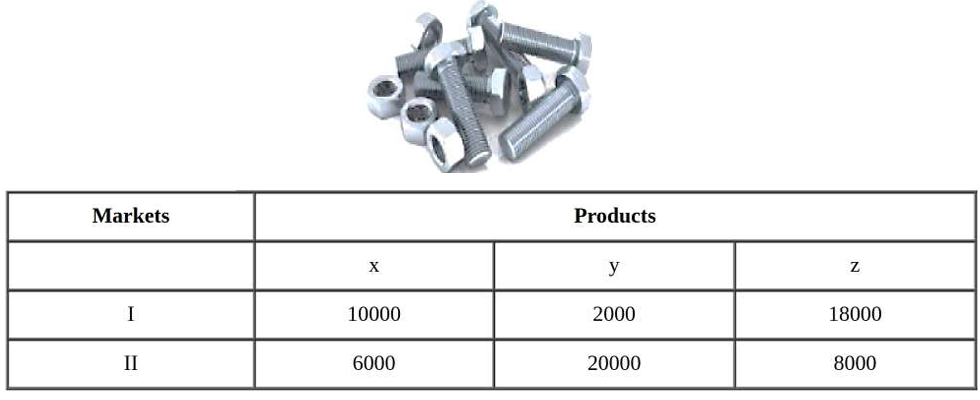
(i) If unit sales prices of $x, y$ and $z$ are $₹ 2.50$, ₹ 1.50 and $₹ 1.00$ respectively, then find the total revenue collected from Market-I \&II.
(ii) If the unit costs of the above three commodities are ₹2.00, ₹ 1.00 and 50 paise respectively, then find the cost price in Market I and Market II.
(iii) If the unit costs of the above three commodities are ₹2.00, ₹1.00 and 50 paise respectively, then find gross profit from both the markets.
OR
If matrix $\mathrm{A}=\left[a_{i j}\right]_{2 \times 2}$ where $\mathrm{a}_{\mathrm{ij}}=1$, if $\mathrm{i} \neq \mathrm{j}$ and $\mathrm{a}_{\mathrm{ij}}=0$, if $\mathrm{i}=\mathrm{j}$ then find $\mathrm{A}^2$.
View full solution →Three schools A, B and C organized a mela for collecting funds for helping the rehabilitation of flood victims. They sold handmade fans, mats, and plates from recycled material at a cost of ₹ 25 , ₹ 100 and ₹ 50 each. The number of articles sold by school A, B, C are given below.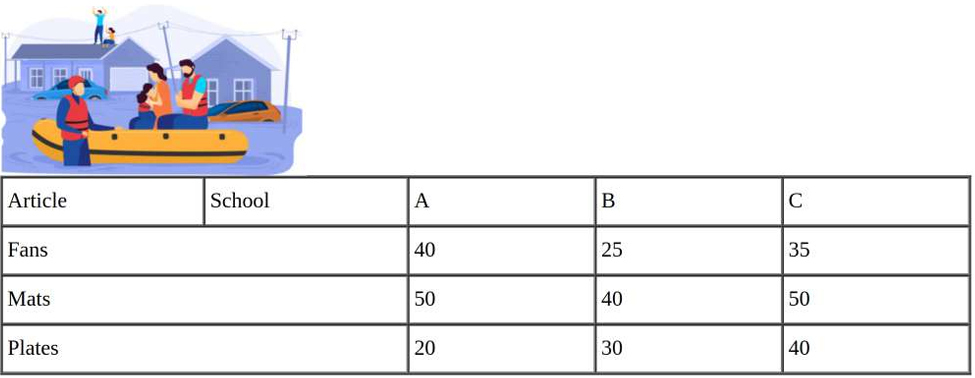
(i) Represent the sale of handmade fans, mats and plates by three schools A, B and C and the sale prices (in ₹) of given products per unit, in matrix form.
(ii) Find the funds collected by school A, B and C by selling the given articles.
(iii) If they increase the cost price of each unit by $20 \%$, then write the matrix representing new price.
OR
Find the total funds collected for the required purpose after $20 \%$ hike in price.
View full solution →Read the following passage and answer the questions given below. 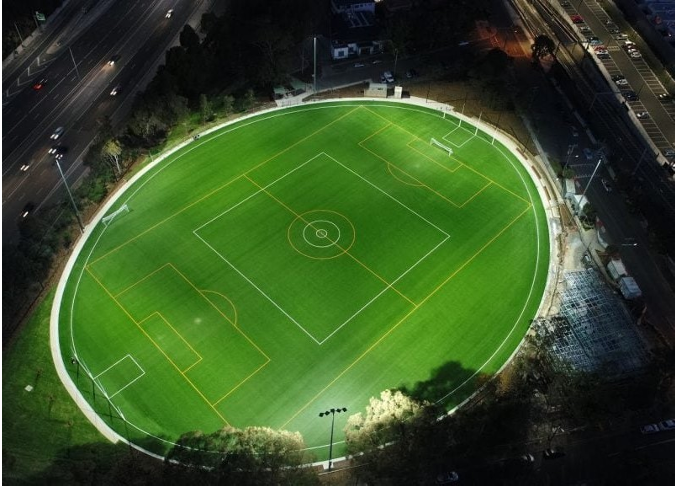
In an elliptical sport field the authority wants to design a rectangular soccer field with the maximum possible area. The sport field is given by the graph of $\frac{x^2}{a^2}+\frac{y^2}{b^2}=1$
(i) If the length and the breadth of the rectangular field be $2 x$ and $2 y$ respectively, then find the area function in terms of $x$.
(ii) Find the critical point of the function.
(iii) Use First derivative Test to find the length $2 x$ and width $2 y$ of the soccer field (in terms of $a$ and b) that maximize its area.
OR
(iii) Use Second Derivative Test to find the length $2 x$ and width $2 y$ of the soccer field (in terms of $a$ and $b$ ) that maximize its area.
View full solution →