MCQ
$Assertion :$ A thin stainless steel needle can lay floating on a still water surface.
$Reason :$ Any object floats when the buoyancy force balances the weight of the object
  • A
    If both Assertion and Reason are correct and the Reason is a correct explanation of the Assertion.
  • If both Assertion and Reason are correct but Reason is not a correct explanation of the Assertion.
  • C
    If the Assertion is correct but Reason is incorrect.
  • D
    If both the Assertion and Reason are incorrect.
Answer

Correct option: B.
If both Assertion and Reason are correct but Reason is not a correct explanation of the Assertion.
b
Assertion and Reason are correct. But Reason does not explain Assertion. Explanation of Assertion is that it is the surface tension of the water surface which is balancing the weight of the steel needle.

Need a full question paper?

Generate a complete, print-ready paper with questions like this in minutes — across 16+ boards, with answer keys.

Start Generating Free

Similar questions

There are two spherical balls $A$ and $B$ of the same material with same surface, but the diameter of $A$ is half that of $B$. If $A$ and $B$ are heated to the same temperature and then allowed to cool, then
When the displacement of a simple harmonic oscillator is one third of its amplitude, the ratio of total energy to the kinetic energy is $\frac{x}{8}$, where $x=$_____________.
A uniform wooden stick of mass $1.6 \mathrm{~kg}$ and length $l$ rests in an inclined manner on a smooth, vertical wall of height $h( < l)$ such that a small portion of the stick extends beyond the wall. The reaction force of the wall on the stick is perpendicular to the stick. The stick makes an angle of $30^{\circ}$ with the wall and the bottom of the stick is on a rough focr. The reaction of the wall on the stick is equal in magnitude to the reaction of the floor on the st $ck$. The ratio $h / l$ and the frictional force $f$ at the bottom of the stick are $\left(g=10 \mathrm{~m} \mathrm{~s}^{-2}\right)$
A man walks on a straight road from his home to a market $2.5 \,km$ away with a speed of $5\, \,km/h$. Finding the market closed, he instantly turns and walks back home with a speed of $7.5 \,km/h$. The average speed of the man over the interval of time $0$ to $40 \,min$. is equal to
According to Kinetic theory of gases, molecules are:
A mass $m$ is attached to a thin wire and whirled in a vertical circle. The wire is most likely to break when
A body of mass $M$ moves with velocity $v$ and collides elastically with a another body of mass $m$ ($M>>m$) at rest then the velocity of body of mass $m$ is
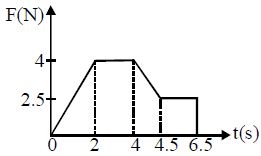
A body old $2\ kg$ has an initial speed $5\ ms^{-1}$ . A force acts on it for some time in the direction of motion. The force time graph is shown in figure. The final speed of the body .......... $ms^{-1}$
$50 \,cal$ of heat is required to raise the temperature of $1$ mole of an ideal gas from $20^{\circ} C$ to $25^{\circ} C$, while the pressure of the gas is kept constant. The amount of heat required to raise the temperature of the same gas through same temperature range at constant volume is ........ $cal$ $(R=2 \,cal / mol -K )$
A particle moves in a straight line so that its displacement $x$ at any time $t$ is given by $x^2=1+t^2$. Its acceleration at any time $\mathrm{t}$ is $\mathrm{x}^{-\mathrm{n}}$ where $\mathrm{n}=$ . . . . .