MCQ
Assertion : Bohr had to postulate that the electrons in stationary orbits around the nucleus do not radiate.
Reason : According to classical physics all moving electrons radiate
  • A
    If both Assertion and Reason are correct and the Reason is a correct explanation of the Assertion.
  • If both Assertion and Reason are correct but Reason is not a correct explanation of the Assertion.
  • C
    If the Assertion is correct but Reason is incorrect.
  • D
    If both the Assertion and Reason are incorrect.
Answer

Correct option: B.
If both Assertion and Reason are correct but Reason is not a correct explanation of the Assertion.
b
According to classical physics all moving electrons around the nucleus will radiate because an accelerated electron in electric field will radiate e.m. wave. So Reason is correct. But Reason does not explain the Assertion. Bohr's postulates that the electron in stationary orbits do not radiate. His postulate was based not out of compulsion but on the quantum theory. So Assertion is also correct but Reason does not explain Assertion

Need a full question paper?

Generate a complete, print-ready paper with questions like this in minutes — across 16+ boards, with answer keys.

Start Generating Free

Similar questions

When a metal surface is illuminated by light of wavelengths $400\; nm$ and $250\; nm$, the maximum velocities of the photoelectrons ejected are $v$ and $2v$ respectively. The work function of the metal is $(h =$ Planck’s constant, $c =$ velocity of light in air)
An electron experiences a force equal to its weight when placed in an electric field. The intensity of the field will be
The zone in a semiconductor diode where no free charge carriers exists is known as the :
A proton and an $\alpha$ -particle are accelerated through a potential difference of $100\, V$. The ratio of the wavelength associated with the proton to that associated with an $\alpha$ -particle is
The resistance of a rectangular block of copper of dimensions $2 \,mm \times 2 \,mm \times 5 \,m$ between two square faces is $0.02 \,\Omega$. What is the resistivity of copper?
The properties of a surface are different from those of the bulk liquid because the surface molecules:
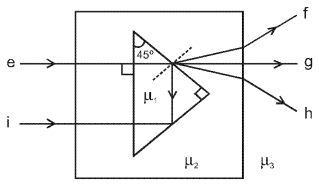
A right angled prism of refractive index $\mu_1$ is placed in a rectangular block of refractive index $\mu_2$, which is surrounded by a medium of refractive index $\mu_3$, as shown in the figure, A ray of ligth 'e' enters the rectangular block at normal incidence. Depending upon the relationships between $\mu_1, \mu_2$ and $\mu_3$, it takes one of the four possible paths $'ef', 'eg', 'eh'$ or $'ei'$. $Image$

Match the paths in List $I$ with conditions of refractive indices in List $II$ and select the correct answer using the codes given below the lists :

List $I$ List $II$
$P$. $\quad e \rightarrow f$ $1.$ $\quad \mu_1>\sqrt{2} \mu_2$
$Q.$ $\quad e \rightarrow g$ $2.$ $\quad \mu_1>\mu_1$ and $\mu_2>\mu_3$
$R.$ $\quad e \rightarrow h$ $3.$ $\quad \mu_1=\mu_2$
$S.$ $\quad e \rightarrow i$ $4.$ $\quad \mu_2<\mu_1<\sqrt{2} \mu_2$ and $\mu_2>\mu_3$

Codes: $\quad \quad P \quad Q \quad R \quad S $ 

An infinite number of charges each numerically equal to q and of the same sign are placed along the $x-$ axis at $x = 1,2,4,8.... \,metres$. Then the electric potential at $x = 0$ due to this set of charges is
The amplification factor of a triode valve is $15$. If the grid voltage is changed by $0.3 \,volt$  the change in plate voltage in order to keep the plate current constant (in volt) is
The physical sizes of the transmitter and receiver antenna in a communication system are