Question
Assertion  :   Dielectric breakdown occurs under the influence of an intense light beam.
Reason      : Electromagnetic radiations exert pressure.(a) If both assertion and reason are true and the reason is the correct explanation of the assertion.(b) If both assertion and reason are true but reason is not the correct explanation of the assertion.(c) If assertion is true but reason is false.(d) If the assertion and reason both are false.


Answer

(b) If both assertion and reason are true but reason is not the correct explanation of the assertion.

Need a full question paper?

Generate a complete, print-ready paper with questions like this in minutes — across 16+ boards, with answer keys.

Start Generating Free

Similar questions

Check the incorrect statement: When a magnet is moved into a coil the strength of the current depends on:
In a semiconductor diode, the depletion region is removed when:
At the time of total solar eclipse, the spectrum of solar radiation would be (a) A large number of dark Fraunhofer lines(b) A less number of dark Fraunhofer lines(c) No lines at all(d) All Fraunhofer lines changed into brilliant colours


An organ pipe, open at both ends, contains
  1. Longitudinal stationary waves.
  2. Longitudinal travelling waves.
  3. Transverse stationary waves.
  4. Transverse travelling waves.
Light waves producing interference have their amplitudes in the ratio 3 : 2. The intensity ratio of maximum and minimum of interference fringes is(a) 36 : 1 (b) 9 : 4(c) 25 : 1 (d) 6 : 4
       
When light travels from one medium to the other of which the refractive index is different, then which of the following will change(a) Frequency, wavelength and velocity(b) Frequency and wavelength(c) Frequency and velocity(d) Wavelength and velocity
   
   
Kinetic energy of emitted cathode rays is dependent on(a) Only voltage(b) Only work function(c) Both (a) and (b)(d) It does not depend upon any physical quantity


When a current passes through a wire whose different parts are maintained at different temperatures, evolution or absorption of heat all along the length of wire is known as(a) Joule effect(b) Seebeck effect(c) Peltier effect(d) Thomson effect
       
A sphere is rolled on a rough horizontal surface. It gradually slows down and stops. The force of friction tries to:
  1. Decrease the linear velocity.
  2. Increase the angular velocity.
  3. Increase the linear momentum.
  4. Decrease the angular velocity.
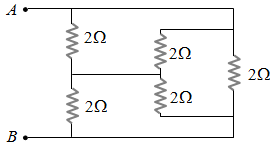
Find the equivalent resistance across $AB$