Question

Assertion  :   For a perfectly diamagnetic substance permeability is always one.

Reason       : The ability of a material of permit the passage of magnetic lines of force through it is called magnetic permeability.

(a) If both assertion and reason are true and the reason is the correct explanation of the assertion.

(b) If both assertion and reason are true but reason is not the correct explanation of the assertion.

(c) If assertion is true but reason is false.

(d) If assertion is false but reason is true.

Answer

(d) If assertion is false but reason is true.

Need a full question paper?

Generate a complete, print-ready paper with questions like this in minutes — across 16+ boards, with answer keys.

Start Generating Free

Similar questions

The focal length of the objective of a compound microscope if fo and its distance from the eyepiece is L. The object is placed at a distance u from the objective. For proper working of the instrument:
  1. L < u
  2. L > u
  3. fo < L < 2fo
  4. L > 2fo
The minimum orbital angular momentum of the electron in a hydrogen atom is:

A radioactive sample at any instant has its disintegration rate 5000 disintegration per minute. After 5 minutes, the rate is 1250 disintegrations per minute. Then, the decay constant (per minute) is

(a) 0.8 In 2

(b) 0.4 In 2

(c) 0.2 In 2

(d) 0.1 In 2

A condenser of capacity  50μF is charged to 10 volts. Its energy is equal to

(a) 2.5  

(b) 2.5  

(c) 5 

(d) 1.2  

If a body is charged by rubbing it, its weight:
Find out correct option which describe the Red shift of distant galaxies.

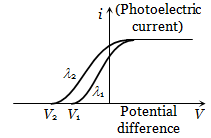
In the following diagram if V2 > V1 then

(a)  

(b)  

(c)  

(d)   

An LC resonant circuit contains a 400 pF capacitor and a 100 mH inductor. It is set into oscillation coupled to an antenna. The wavelength of the radiated electromagnetic waves is

(a) 377 mm

(b) 377 metre

(c) 377 cm

(d) 3.77 cm

A body is in pure rotation. The linear speed $\nu$ of a particle, the distance r of the particle from the axis and the angular velocity $\omega$ of the body are related as $\omega=\frac{\text{v}}{\text{r}}$ Thus:

  1. $\omega\propto\frac{1}{\text{r}}$

  2. $\omega\propto\text{r}$

  3. $\omega=0$

  4. $\omega$ is independent of r.

The magnitude of gravitational potential energy of the moon-earth system is U with zero potential energy at infinite separation. The kinetic energy of the moon with respect to the earth is K.
  1. U < K
  2. U > K
  3. U = K