MCQ
$Assertion$ : For a system of particles under central force field, the total angular momentum is conserved.
$Reason$ : The torque acting on such a system is zero.
  • If both Assertion and Reason are correct and the Reason is a correct explanation of the Assertion.
  • B
    If both Assertion and Reason are correct but Reason is not a correct explanation of the Assertion.
  • C
    If the Assertion is correct but Reason is incorrect.
  • D
    If both the Assertion and Reason are incorrect.
Answer

Correct option: A.
If both Assertion and Reason are correct and the Reason is a correct explanation of the Assertion.
a
Under central force field, force acts along the line joining the bodies so it does not have rotatory effect i.e., torque is zero. Hence angular momentum is conservative

Need a full question paper?

Generate a complete, print-ready paper with questions like this in minutes — across 16+ boards, with answer keys.

Start Generating Free

Similar questions

Two bodies of mass $10 \,kg$ and $5 \,kg$ moving in concentric orbits of radii $R$ and $r$ such that their periods are the same. Then the ratio between their centripetal acceleration is
$300 \,cal$. of heat is given to a heat engine and it rejects $225 \,cal$. of heat. If source temperature is $227^{\circ} C$, then the temperature of sink will be____${ }^{\circ} C$.
A body is executing simple harmonic motion with an angular frequency $2\,rad/s$. The velocity of the body at $20\, mm$ displacement, when the amplitude of motion is $60\, mm$, is ...... $mm/s$
A cylindrical tank has a hole of $1 cm^2$ in its bottom. If the water is allowed to flow into the tank from a tube above it at the rate of $70 cm^3/sec$. then the maximum height up to which water can rise in the tank is  .......... $cm$
From a circular disc of radius $R$ and mass $9 M$, a small disc of mass $M$ and radius $\frac{R}{3}$ is removed concentrically. The moment of inertia of the remaining disc about an axis perpendicular to the plane of the disc and passing through its centre is
A spring with spring constant $k $  is extended from $x = 0$to$x = {x_1}$. The work done will be
A particle of mass $m$ moves in a circular orbit under the central potential field, $U ( r )=\frac{- C }{ r }$, where $C$ is a positive constant

The correct radius - velocity graph of the particle's motion is:

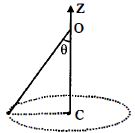
A conical pendulum of length $1\,m$ makes an angle $\theta \, = 45^o$ w.r.t. $Z-$ axis and moves in a circle in the $XY$ plane.The radius of the circle is $0.4\, m$ and its centre is vertically below $O$. The speed of the pendulum, in its circular path, will be ..... $m/s$ (Take $g\, = 10\, ms^{-2}$)
Assume that a drop of liquid evaporates by decrease in its surface energy, so that its temperature remains unchanged. What should be the minimum radius of the drop for this to be possible? The surface tension is $T$, density of liquid is $\rho$ and $L$ is its latent heat of vaporization
A weightless thread can bear a tension upto $3.7\,kg-wt$ . A stone of mass $500\,g$ is tied to it and revolved in a circular path of radius $4\,m$ in a vertical plane. If $g = 10\,ms^{-2}$, then the maximum angular velocity of the stone will be ......... $rad\,s^{-1}$