MCQ
$Assertion$ : If collision occurs between two elastic bodies their kinetic energy decreases during the time of collision.

$Reason$ : During collision intermolecular space decreases and hence elastic potential energy increases.

  • If both Assertion and Reason are correct and the Reason is a correct explanation of the Assertion.
  • B
    If both Assertion and Reason are correct but Reason is not a correct explanation of the Assertion.
  • C
    If the Assertion is correct but Reason is incorrect.
  • D
    If both the Assertion and Reason are incorrect.
Answer

Correct option: A.
If both Assertion and Reason are correct and the Reason is a correct explanation of the Assertion.
a
During collision intermolecular space decreases and hence elastic potential energy increases and since the total energy of system has to be constant $K.E.$ decreases for a very short period of time.

Need a full question paper?

Generate a complete, print-ready paper with questions like this in minutes — across 16+ boards, with answer keys.

Start Generating Free

Similar questions

There is a relationship between the pressure P of an ideal gas and the average kinetic energy E of the gas in unit volume.
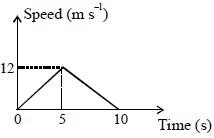
The speed-time graph of a particle moving along a fixed direction is shown in the figure. The distance traversed by the particle between $t = 2\,s$ to $t = 6\,s$ is........$m$
A plank is resting on a horizontal ground in the northern hemisphere of the earth at a $45^{\circ}$ latitude. Let the angular speed of the earth be $\omega$ and its radius $r_e$. The magnitude of the frictional force on the plank will be
A particle moves in a circular path with a uniform speed. Its motion is:
  1. Periodic.
  2. Oscillatory.
  3. Simple harmonic.
  4. Angular simple harmonic.
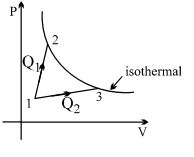
A gas takes part in two processes in which it is heated from the same initial state $1$ to the same final temperature. The processes are shown on the $P-V$ diagram by the straight line $1-2$ and $1-3$. $2$ and $3$ are the points on the same isothermal curve. $Q_1$ and $Q_2$ are the heat transfer along the two processes. Then
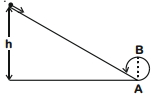
A body initially at rest and sliding along a frictionless track from a height $h$ (as shown in the figure) just completes a vertical circle of diameter $AB =D$ . The height $h$ is equal to 
A ball of weight $0.1\, kg$ coming with speed $30\, m/s$ strikes with a bat and returns in opposite direction with speed $40 \,m/s$, then the impulse is (Taking final velocity as positive)
The ratio of frequencies of fundamental harmonic produced by an open pipe to that of closed pipe having the same length is
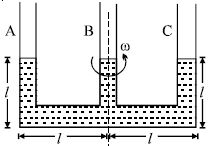
Figure shows a three arm tube in which a liquid is filled upto levels of height $l$. It is now rotated at an angular frequency $\omega$ about an axis passing through arm $B$. The angular frequency $\omega$ at which level of liquid in arm $B$ becomes zero. 
An ideal gas is subjected to an isothermal expansion such that its volume changes from $V_i$ to $V_f$ and pressure from $P_i$ to $P_f$. The work done on the gas is :