MCQ
Assertion : In a cavity within a conductor, the electric field is zero.

Reason : Charges in a conductor reside only at its surface

  • If both Assertion and Reason are correct and the Reason is a correct explanation of the Assertion.
  • B
    If both Assertion and Reason are correct but Reason is not a correct explanation of the Assertion.
  • C
    If the Assertion is correct but Reason is incorrect.
  • D
    If both the Assertion and Reason are incorrect.
Answer

Correct option: A.
If both Assertion and Reason are correct and the Reason is a correct explanation of the Assertion.
a
Net field inside the conductor is zero because by virtue of induced charges, applied and induced electric fields are equal and opposite thus the net charge resides on surface only. If any cavity is there inside the conductor, electric field will be zero in it.

Need a full question paper?

Generate a complete, print-ready paper with questions like this in minutes — across 16+ boards, with answer keys.

Start Generating Free

Similar questions

An alternating voltage of amplitude $40 \mathrm{~V}$ and frequency $4 \mathrm{kHz}$ is applied directly across the capacitor of $12 \mu \mathrm{F}$. The maximum displacement current between the plates of the capacitor is nearly:
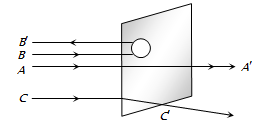
A beam of fast moving alpha particles were directed towards a thin film of gold. The parts A';B' and C' of the transmitted and reflected beams corresponding to the incident parts A, B and C of the beam, are shown in the adjoining diagram. The number of alpha particles in
The electric field of a plane electromagnetic wave is given by

$\overrightarrow{\mathrm{E}}=\mathrm{E}_{0} \frac{\hat{\mathrm{i}}+\hat{\mathrm{j}}}{\sqrt{2}} \cos (\mathrm{kz}+\omega \mathrm{t})$ At $\mathrm{t}=0,$ a positively charged particle is at the point $(\mathrm{x}, \mathrm{y}, \mathrm{z})=\left(0,0, \frac{\pi}{\mathrm{k}}\right) .$ If its instantaneous velocity at $(t=0)$ is $v_{0} \hat{\mathrm{k}},$ the force acting on it due to the wave is

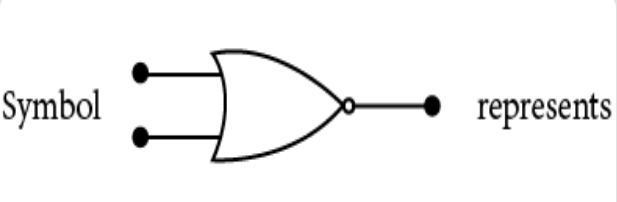
Identify the logic gate in figure.
$(i)$ The wavelength of microwaves is greater than that of $UV$-rays.

$(ii)$ The wavelength of $IR$ rays is less than that of $UV$-rays.

$(iii)$ The wavelength of microwaves is lesser than that of $IR$ rays.

$(iv)$ Gamma rays have shortest wavelength in the electromagnetic spectrum.

Of the above statements

The force of repulsion between two point charges is $F$, when these are $1m$ apart. Now the point charges are replaced by conducting spheres of radii $5\ cm$ having the charge same as that of point charges. The distance between their centres is $1m$, then the force of repulsion will:
The wavelength of light in two liquids ‘x' and ‘y' is 3500 Å and 7000 Å, then the critical angle of x relative to y will be
Consider a thin spherical shell of radius $R$ with its centre at the origin, carrying uniform positive surface charge density. The variation of the magnitude of the electric field $|\vec{E}(r)|$ and the electric potential $V(r)$ with the distance r from the centre, is best represented by which graph?
The de-Broglie wavelength of a neutron at $27^{\circ} \mathrm{C}$ is I . What will be its wavelength at $927^{\circ} \mathrm{C}$
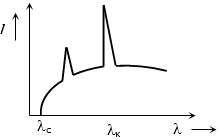
The intensity of $X-$ rays from a Coolidge tube is plotted against wavelength as shown in the figure. The minimum wavelength found is ${\lambda _c}$ and the wavelength of the ${K_\alpha } $ line is ${\lambda _k}$. As the accelerating voltage is increased