MCQ
Assertion : In a movie, ordinarily $24$ frames are projected per second from one end to the other of the complete film.

Reason : The image formed on retina of eye is sustained upto $1/10\,second$ after the removal of stimulus.

  • A
    If both Assertion and Reason are correct and the Reason is a correct explanation of the Assertion.
  • B
    If both Assertion and Reason are correct but Reason is not a correct explanation of the Assertion.
  • If the Assertion is correct but Reason is incorrect.
  • D
    If both the Assertion and Reason are incorrect.
Answer

Correct option: C.
If the Assertion is correct but Reason is incorrect.
c
The image formed on retina of eye is sustained upto $\frac {1}{16}^{th}$ second after removal of stimulus. So, number of frames to be projected on the screen must be at most $16$ per second.

Need a full question paper?

Generate a complete, print-ready paper with questions like this in minutes — across 16+ boards, with answer keys.

Start Generating Free

Similar questions

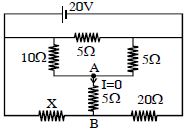
In given circuit current through $AB$ is zero, then what will be the value of unknown resistance $'X'$ ............... $\Omega$
In a compound microscope, the focal length of the objective and the eye lens are $2.5 \,cm$ and $5 \,cm$ respectively. An object is placed at $3.75\, cm$ before the objective and image is formed at the least distance of distinct vision, then the distance between two lenses will be......$cm$ ($i.e.$ length of the microscopic tube)
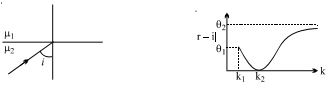
The figure shows a ray incident at an angle $i = \pi /3$. If the plot drawn shown the variation of $| r - i |$ versus $\frac{{{\mu _1}}}{{{\mu _2}}} = k,$ $(r =$ angle of refraction) 
What will be the colour of sky as seen from the earth, if there were no atmosphere
In Young's double slit experiment, if one of the slit is closed fully, then in the interference pattern
Assertion : The colour of the green flower seen through red glass appears to be dark.
Reason : Red glass transmits only red light.
What is the time taken (in seconds) to cross a glass of thickness 4 mm and μ = 3 by light
Three photons coming from excited atomic-hydrogen sample are picked up. Their energies are 12.1eV, 10.2 eV and 1.9eV. These photons must come from:
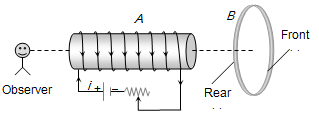
An aluminium ring B faces an electromagnet A. The current I through A can be altered
Two charges $q_1$ and $q_2$ are placed in vacuum at a distance d and the force acting between them is F. If a medium of dielectric constant 4 is introduced around them, the force now will be