Question

Assertion : Interference pattern is made by using blue light instead of red light, the fringes becomes narrower.

Reason      :  In Young’s double slit experiment, fringe width is given by relation B =

(a) If both assertion and reason are true and the reason is the correct explanation of the assertion.

(b) If both assertion and reason are true but reason is not the correct explanation of the assertion.

(c) If assertion is true but reason is false.

(d) If the assertion and reason both are false.

Answer

(a) If both assertion and reason are true and the reason is the correct explanation of the assertion.

Need a full question paper?

Generate a complete, print-ready paper with questions like this in minutes — across 16+ boards, with answer keys.

Start Generating Free

Similar questions

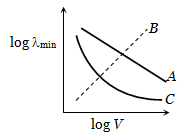
The dependence of the short wavelength limit   on the accelerating potential V is represented by the curve of figure

(a) A 

(b) B 

(c) C 

(d) None of these

Ultraviolet radiations of 6.2eV  falls on an aluminium surface (work function 4.2 eV). The kinetic energy in joules of the fastest electron emitted is approximately

(a) 3.2  

(b) 3.2  

(c) 3.2  

(d) 3.2  

Wavelength of a particle of mass $m$ moving with velocity V is :

Fraunhofer lines are produced by

(a) The element present in the photosphere of sun

(b) The elements present in the chromosphere of the sun

(c) The vapour of the element present in the chromosphere of the sun

(d) The carbon dioxide present in the atmosphere

In Cu-Fe couple, the flow of current at the temperature of inversion is

(a) From Fe to Cu through the hot junction

(b) From Cu to Fe through the hot junction

(c) Maximum

(d) None of the above

The displacement of a particle is given by $\overrightarrow{\text{r}}=\text{A}\big(\overrightarrow{\text{i}}\cos\omega\text{t}+\overrightarrow{\text{j}}\sin\omega\text{t}\big)$ The motion of the particle is:
  1. Simple harmonic.
  2. On a straight line.
  3. On a circle.
  4. With constant acceleration.
On increasing the distance between the light source and the photoelectric cell, the value of stopping potential changes :
For which frequency of light, the human eye is most sensitive?

The potential difference applied to an X-ray tube is 5kV and the current through it is 3.2 mA. Then the number of electrons striking the target per second is

(a) 2  

(b) 5 

(c) 1 

(d) 4 

In a wave, the path difference corresponding to a phase difference of f is

(a)  

(b)

(c)

(d)