MCQ
For which frequency of light, the human eye is most sensitive?
- A55.405 × 1014 Hz
- B95.405 × 1014 Hz
- C5.405 × 1014 Hz
- D79.405 × 1014 Hz
Explanation:
Human eye is sensitive to light of wavelength ➔ $\lambda$ = 5550 angstrom.
So its frequency is $\text{v}=\frac{\text{c}}{\lambda}$
$\text{v} =\frac{5550}{3 × 10^8} × 10^{-10}$
v = 5.405 × 10¹⁴ Hz
Generate a complete, print-ready paper with questions like this in minutes — across 16+ boards, with answer keys.
In a copper voltameter, mass deposited in 6 minutes is m gram. If the current-time graph for the voltameter is as shown here, then the E.C.E of the copper is
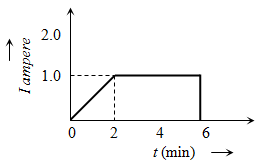
|
(a) m / 5 |
(b) m / 300 |
(c) 5 m |
(d) m / 18000 |
In the case of bar magnet, lines of magnetic induction
|
(a) Start from the north pole and end at the south pole |
|
(b) Run continuously through the bar and outside |
|
(c) Emerge in circular paths from the middle of the bar |
|
(d) Are produced only at the north pole like rays of light from a bulb |
Assertion : When a tiny circular obstacle is placed in the path of light from some distance, a bright spot is seen at the centre of shadow of the obstacle.
Reason : Destructive interference occurs at the centre of the shadow.
|
(a) If both assertion and reason are true and the reason is the correct explanation of the assertion. |
|
(b) If both assertion and reason are true but reason is not the correct explanation of the assertion. |
|
(c) If assertion is true but reason is false. |
|
(d) If the assertion and reason both are false. |
Some electric bulbs are connected in series across a 220 V supply in a room. If one bulb is fused then remaining bulbs are connected again in series across the same supply. The illumination in the room will
|
(a) Increase |
(b) Decrease |
(c) Remains the same |
(d) Not continuous |
A man runs towards a mirror at a speed 15 m/s The speed of the image relative to the man is
|
(a) 15 |
(b) 30 |
(c) 35 |
(d) 20 |
