Question

Assertion  :   Magnetism is relativistic.

Reason      : When we move along with the charge so that there is no motion relative to us, we find no magnetic field associated with the charge.

(a) If both assertion and reason are true and the reason is the correct explanation of the assertion.

(b) If both assertion and reason are true but reason is not the correct explanation of the assertion.

(c) If assertion is true but reason is false.

(d) If the assertion and reason both are false.

Answer

(a) If both assertion and reason are true and the reason is the correct explanation of the assertion.

Need a full question paper?

Generate a complete, print-ready paper with questions like this in minutes — across 16+ boards, with answer keys.

Start Generating Free

Similar questions

If the velocity of a charged particle is made twice and that of magnetic field is made half then the radius of the circular path of the charged particle in the magnetic field will become :
Magnitude of pursuit velocity does not depend on :

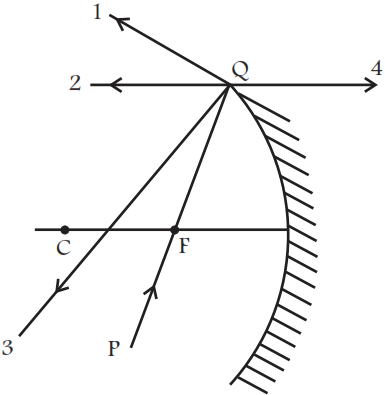
The direction of ray of light incident on a concave mirror is shown by PQ while directions in which the ray would travel after reflection is shown by four rays marked 1, 2, 3 and 4 (Fig). Which of the four rays correctly shows the direction of reflected ray?

A parallel combination of two capacitors of capacitance $C_1$ and $C_2$ is given a charge $Q$. If there is $Q_1$ charge on $C_1$ and $Q_2$ charge on $C_2$, the ratio of $\frac{Q_1}{Q_2}$ will be:

A bar magnet is oscillating in the Earth’s magnetic field with a period T. What happens to its period and motion if its mass is quadrupled

(a) Motion remains S.H.M. with time period = 2T

(b) Motion remains S.H.M. with time period = 4T

(c) Motion remains S.H.M. and period remains nearly constant

(d) Motion remains S.H.M. with time period =  

A hollow conducting sphere is placed in an electric field produced by a point charge placed at P as shown in figure. Let   be the potentials at points A, B  and C respectively. Then

(a)  

(b)  

(c)  

(d)  

In the circuit shown, A and V are ideal ammeter and voltmeter respectively. Reading of the voltmeter will be

(a) 2 V     

(b) 1 V

(c) 0.5 V  

(d) Zero

When the current i is flowing through a conductor, the drift velocity is v. If  2i  current is flowed through the same metal but having double the area of cross-section, then the drift velocity will be

(a) v/4

(b) v/2

(c) v  

(d) 4v

Serious draw back of the semiconductor device is

(a) They cannot be used with high voltage

(b) They pollute the environment

(c) They are costly

(d) They do not last for long time

The binding energy of the innermost electron in tungsten is 40 keV. To produce characteristic X-rays using a tungsten target in an X-rays tube the potential difference V between the cathode and the anti-cathode should be

(a) V< 40 kV

(b) V  40 kV

(c) V > 40 kV

(d) V >/< 40 kV