Question
Assertion  :  Microwave communication is preferred over optical communication.
Reason      : Microwaves provide large number of channels and band width compared to optical signals. (a) If both assertion and reason are true and the reason is the correct explanation of the assertion.(b) If both assertion and reason are true but reason is not the correct explanation of the assertion.(c) If assertion is true but reason is false.(d) If the assertion and reason both are false.


Answer

(a) If both assertion and reason are true and the reason is the correct explanation of the assertion.

Need a full question paper?

Generate a complete, print-ready paper with questions like this in minutes — across 16+ boards, with answer keys.

Start Generating Free

Similar questions

Let p and E denote the linear momentum and energy of a photon. If the wavelength is decreased:
Assertion  :  Two P-N junction diodes placed back to back, will work as a NPN transistor.
Reason     : The P-region of two PN junction diodes back to back will form the base of NPN transistor.(a) If both assertion and reason are true and the reason is the correct explanation of the assertion.(b) If both assertion and reason are true but reason is not the correct explanation of the assertion.(c) If assertion is true but reason is false.(d) If the assertion and reason both are false.


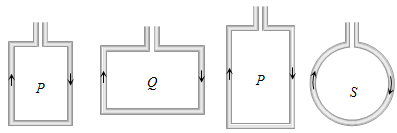
Four wires each of length $2.0$ metres are bent into four loops $P, Q, R$ and $S$ and then suspended into uniform magnetic field. Same current is passed in each loop. Which statement is correct
When does a magnetic dipole possess maximum potential energy inside a magnetic field?
Two plates are 2 cm  apart, a potential difference of 10 volt  is applied between them, the electric field between the plates is(a) 20 N/C (b) 500 N/C(c) 5 N/C    (d) 250 N/C
       
Earth's electric potential is considered:
If the radioactive decay constant of radium is $1.07 \times 10^{-4}$ per year, then its half life period is approximately equal to
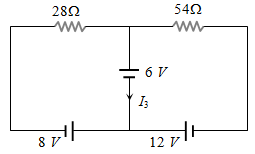
Consider the circuit shown in the figure. The current $I_3$  is equal to          
Spherical aberration in a lens(a) Is minimum when most of the deviation is at the first surface(b) Is minimum when most of the deviation is at the second surface(c) Is minimum when the total deviation is equally distributed over the two surface (d) Does not depend on the above consideration


The direction of induced e.m.f. during electromagnetic induction is given by(a) Faraday's law(b) Lenz's law(c) Maxwell's law(d) Ampere's law