MCQ
Assertion : No interference pattern is detected when two coherent sources are infinitely close to each other.

Reason : The fringe width is inversely proportional to the distance between the two slits.

  • If both Assertion and Reason are correct and the Reason is a correct explanation of the Assertion.
  • B
    If both Assertion and Reason are correct but Reason is not a correct explanation of the Assertion.
  • C
    If the Assertion is correct but Reason is incorrect.
  • D
    If both the Assertion and Reason are incorrect.
Answer

Correct option: A.
If both Assertion and Reason are correct and the Reason is a correct explanation of the Assertion.
a
When $d$ is negligibly small, fringe width $\beta $ which is proportional to $1/d$ may become too large. Even a single fringe may occupy the whole screen. Hence the pattern cannot be detected.

Need a full question paper?

Generate a complete, print-ready paper with questions like this in minutes — across 16+ boards, with answer keys.

Start Generating Free

Similar questions

An electron moving in a circular orbit of radius $r$ makes $n$ rotation per second. The magnetic field produced at the centre has a magnitude of
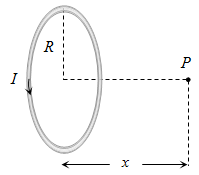
A coil having N turns carry a current I as shown in the figure. The magnetic field intensity at point P is

The origin of $x$ and $y$ coordinates is the pole of a concave mirror of focal length $20\, cm$. The $x$ -axis is the optical axis with $x > 0$ being the real side of mirror. $A$ point object at the point $(25\, cm, 1\, cm)$ is moving with a velocity $10\, cm/s$ in positive $x$ -direction. The velocity of the image in $cm/s$ is approximately
Who first proposed the light as an electromagnetic wave?
A giant refracting telescope at an observatory has an objective lens of focal length $15\,m$. If an eye piece of focal length $1.0\,cm$ is used what is the angular magnification of telescope ?
A student wants to find if a star if moving away from the earth or towards the earth. Which of the following principle he can use?
$\text{LED}$ is a $p-n$ junction diode which is :
An electron is moving along the positive $X$-axis. You want to apply a magnetic field for a short time so that the electron may reverse its direction and move parallel to the negative $X$-axis. This can be done by applying the magnetic field along
A thin rod of $5cm$ length is kept along the axis of a concave mirror of $10cm$ focal length such that its image is real and magnified and one end touches the rod. Its magnification will be
Assertion : Two concentric charged shells are given. The potential difference between the shells depends on charge of inner shell.

Reason : Potential due to charge of outer shell remains same at every point inside the sphere.