MCQ
$\text{LED}$ is a $p-n$ junction diode which is :
  • Forward biased.
  • B
    Either forward biased or reverse biased.
  • C
    Reverse biased.
  • D
    Neither forward biased nor reverse biased.

Answer

Correct option: A.
Forward biased.
An $\text{LED}$ is a light emitting diode. The $\text{LED}$ emits light when it is forward biased and it emits no light when it is reverse biased. The intensity of light is proportional to the square of the current flowing through the device.
When a junction diode is forward biased, energy is released at the junction due to recombination of electrons and holes. In the junction diode made of gallium arsenide or indium phosphide, the energy is released in visible region. Thus, light is emitted form the diode and hence the name 'light emitting diode'.

Need a full question paper?

Generate a complete, print-ready paper with questions like this in minutes — across 16+ boards, with answer keys.
Start Generating Free

Similar questions

A photoelectric surface is illuminated successively by monochromatic light of wavelength $\lambda$ and $\lambda /2$. If the maximum kinetic energy of the emitted photoelectrons in the second case is $3$ times that in the first case, the work function of the surface of the material is 
$(h =$ Planck's constant, $c =$ speed of light $)$ 
Image formed by a concave mirror of focal length $6 \,cm$, is $3$ times of the object, then the distance of object from mirror is......$cm$
The inductance of a coil is 60μH. A current in this coil increases from 1.0 A to 1.5 A in 0.1 second. The magnitude of the induced e.m.f. is
In Bohr model of hydrogen atom, let $P.E$. represents potential energy and $T.E$. represents the total energy. In going to a higher level:
Light from a point source in air falls on a convex spherical glass surface $(\mu = 1.5,$ radius of curvature $= 20\, cm)$ The distance of light source from the glass surface is $100\, cm$. At what position is the image formed.......$cm$
What will be the colour of sky as seen from the earth, if there were no atmosphere
The approximate ratio of resistances in the forward and reverse bias of the PN-junction diode is
Two sources of light emit with a power of $200 \mathrm{~W}$. The ratio of number of photons of visible light emitted by each source having wavelengths $300\  \mathrm{nm}$ and $500 \mathrm{~nm}$ respectively, will be :
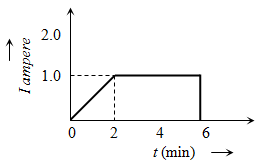
In a copper voltameter, mass deposited in 6 minutes is m gram. If the current-time graph for the voltameter is as shown here, then the E.C.E of the copper is
Assertion : Leclanche cell is used, when constant supply of electric current is not required.
Reason : The e.m.f. of a Leclanche cell falls, if it is used continuously.