MCQ
Assertion : Radioactive nuclei emit ${\beta ^ - }$ particles.

Reason : Electrons exist inside the nucleus

  • A
    If both Assertion and Reason are correct and the Reason is a correct explanation of the Assertion.
  • B
    If both Assertion and Reason are correct but Reason is not a correct explanation of the Assertion.
  • If the Assertion is correct but Reason is incorrect.
  • D
    If both the Assertion and Reason are incorrect.
Answer

Correct option: C.
If the Assertion is correct but Reason is incorrect.
c
Radioactive nuclei emit $\beta  - $ particles. This $\beta  - $ particle comes from the splitting of neutron into $\beta  - $ particle and proton.

Need a full question paper?

Generate a complete, print-ready paper with questions like this in minutes — across 16+ boards, with answer keys.

Start Generating Free

Similar questions

Two wires each of radius of cross section $r$ but of different materials are connected together end to end (in series). If the densities of charge carriers in the two wires are in the ratio $1 : 4$, the drift velocity of electrons in the two wires will be in the ratio:
A convex lens has $9 cm$ focal length and a concave lens has $-18 cm$ focal length. The focal length of the combination in contact will be.....$cm$
Mass energy equation was propounded by:
Some radioactive nucleus may emit
In an electromagnetic wave in free space the root mean square value of the electric field is $E_{rms} = 6\, V m^{-1}$ The peak value of the magnetic field is
Rear window of a car has a size of $120\times 45\,cm^2$. The driver sits at a distance $L = 2\,m$ from the rear window. What should be the minimum size of flat mirror, hanging at a distance of $0.5\,m$ in front of the driver so that he has best view of road situation behind the car ?
In a triode, ${g_m} = 2 \times {10^{ - 3}}oh{m^{ - 1}};\,\mu = 42$, resistance load, $R = 50$ kilo ohm. The voltage amplification obtained from this triode will be
Angular width of the central maxima the Fraunhofer diffraction for $\lambda=6000 \;\mathring A$ is $\theta_{0} .$ When the same slit Is lluminated by another monochromatic light, the angular wildth decreases by $30 \% .$ The wavelength of this light is.......$\mathring A$
When unpolarised light beam is incident from air onto glass $(n = 1.5)$ at the polarising angle
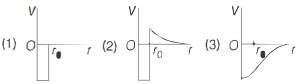
Given below are three schematic graphs of potential energy $V(r)$ versus distance $r$ for three atomic particles : electron $\left(e^{-}\right)$, proton $\left(p^{+}\right)$and neutron $(n)$, in the presence of a nucleus at the origin $O$. The radius of the nucleus is $r_0$. The scale on the $V$-axis may not be the same for all figures. The correct pairing of each graph with the corresponding atomic particle is