MCQ
$Assertion :$ The buoyant force on a submerged rigid object can be considered to be acting at the centre of mass of the object.
$Reason :$ For a rigid body a force field distributed uniformly through its volume can be considered to be acting at the centre of mass of the body.
  • A
    If both Assertion and Reason are correct and the Reason is a correct explanation of the Assertion.
  • B
    If both Assertion and Reason are correct but Reason is not a correct explanation of the Assertion.
  • If the Assertion is correct but Reason is incorrect.
  • D
    If both the Assertion and Reason are incorrect.
Answer

Correct option: C.
If the Assertion is correct but Reason is incorrect.
c

Need a full question paper?

Generate a complete, print-ready paper with questions like this in minutes — across 16+ boards, with answer keys.

Start Generating Free

Similar questions

Size of the universe is of the order of:
If a charged particle kept at rest experiences an electromagnetic force:
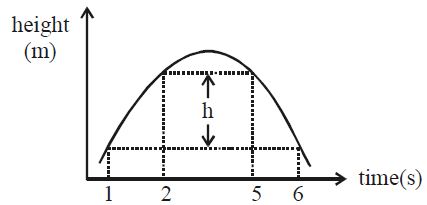
A ball is thrown upwards. Its height varies with time as follows If the acceleration due to gravity is $7.5\, m/s^2$, then the height $h$ is.........$m$
When two particles collide elastically, then impulsive force can't change
A body falling freely under gravity passes two points $30\,m$ apart in $1\,s$ . From what point above the upper point it began to fall?......... $m$ (Take $g = 10\,m\,s^{-2}$ )
In the given figure a ring of mass $m$ is kept on a horizontal surface while a body of equal mass $'m'$ attached through a string, which is wounded on the ring. When the system is released the ring rolls without slipping. Consider the following statements and choose the  correct option.

$(i)$ acceleration of the centre of mass of ring is $\frac{g}{3}$

$(ii)$ acceleration of the hanging particle is  $\frac{2g}{3}$

$(iii)$ frictional force (on the ring) acts along forward direction

$(iv)$ frictional force (on the ring) acts along backward direction

Which relation is wrong
A body falls freely from the top of a tower. It covers $36\%$ of the total height in the last second before striking the ground level. The height of the tower is........$m$
The position of a particle moving in the $xy-$plane at any time $t$ is given by $x = (3{t^2} - 6t)$ metres, $y = ({t^2} - 2t)$ metres. Select the correct statement about the moving particle from the following
A particle of mass $m$ undergoes oscillations about $x=0$ in a potential given by $V(x)-\frac{1}{2} k x^2-V_0 \cos \left(\frac{x}{a}\right)$, where $V_0, k, a$ are constants. If the amplitude of oscillation is much smaller than $a$, the time period is given by