Question

Assertion :  The ion cannot move with a speed beyond a certain limit in a cyclotron.

Reason     : As velocity increases time taken by ion increases.

(a) If both assertion and reason are true and the reason is the correct explanation of the assertion.

(b) If both assertion and reason are true but reason is not the correct explanation of the assertion.

(c) If assertion is true but reason is false.

(d) If the assertion and reason both are false.

Answer

(c) If assertion is true but reason is false.

Need a full question paper?

Generate a complete, print-ready paper with questions like this in minutes — across 16+ boards, with answer keys.

Start Generating Free

Similar questions

The distance between the extreme points on the periphery of the mirror is called:

Two infinitely long parallel wires having linear charge densities   and  respectively are placed at a distance of R metres. The force per unit length on either wire will be   )

(a)  

(b)

(c)

(d)

Value of $(\mu_{0}\in_{0})^{-1/2}$ is :

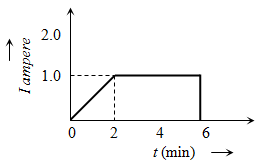
In a copper voltameter, mass deposited in 6 minutes is m gram. If the current-time graph for the voltameter is as shown here, then the E.C.E of the copper is

(a) m / 5  

(b) m / 300

(c) 5 m    

(d) m / 18000

Displacement current goes through the gap between the plates of a capacitor when the charge of the capacitor:
Identify the process in which an electron escapes from the metal surface.
As an electron makes a transition from an excited state to the ground state of a hydrogen - like atom/ion?

An e.m.f. of 100 millivolts is induced in a coil when the current in another nearby coil becomes 10 ampere from zero in 0.1 second. The coefficient of mutual induction between the two coils will be

(a) 1 millihenry

(b) 10 millihenry

(c) 100 millihenry

(d) 1000 millihenry

In a simple harmonic motion:
  1. The maximum potential energy equals the maximum kinetic energy.
  2. The minimum potential energy equals the minimum kinetic energy.
  3. The minimum potential energy equals the maximum kinetic energy.
  4. The maximum potential energy equals the minimum kinetic energy.

Two charges +3.2   and -3.2  kept 2.4 Å apart forms a dipole. If it is kept in uniform electric field of intensity  4   then what will be its electrical energy in equilibrium

(a) + 3

(b) -3  

(c) -6  

(d) -2