MCQ
Assertion : The logic gate $NOT$ can be built using diode.

Reason : The output voltage and the input voltage of the diode have $180^o$ phase difference.

  • A
    If both Assertion and Reason are correct and the Reason is a correct explanation of the Assertion.
  • B
    If both Assertion and Reason are correct but Reason is not a correct explanation of the Assertion.
  • C
    If the Assertion is correct but Reason is incorrect.
  • If both the Assertion and Reason are incorrect.
Answer

Correct option: D.
If both the Assertion and Reason are incorrect.
d
The diode is unidirectional it allows current to pass through it in a particular direction. It does not change the phase of input signal.

Need a full question paper?

Generate a complete, print-ready paper with questions like this in minutes — across 16+ boards, with answer keys.

Start Generating Free

Similar questions

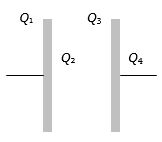
In an isolated parallel plate capacitor of capacitance $C$, the four surface have charges ${Q_1}$, ${Q_2}$, ${Q_3}$ and ${Q_4}$ as shown. The potential difference between the plates is
The layered lens is made of two kinds of glass. A point source of light is placed on its principal axis. If the reflections from the boundaries between layers are ignored, the lens will form
Materials suitable for permanent magnet, must have which of the following properties?
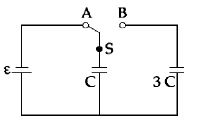
In the figure shown, after the switch $‘S’$ is turned from position $‘A’$ to position $‘B’$, the energy dissipated in the circuit in terms of capacitance $‘C’$ and total charge $‘Q’$ is
The nearest distance between two atoms in case of a $ bcc $ lattice is equal to
Two identical conducting spheres $A$  and $B,$  carry equal charge. They are separated by a distance much larger than their diameter, and the force between them is $F$ . A third identical conducting sphere, $C,$  is uncharged. Sphere $C$  is first touched to $A,$ then to $B,$  and then removed. As a result, the force between $A$  and $B$  would be equal to
Which of the following is not transported by electromagnetic waves?
An electric bulb is made to work at 12 V dc. When this bulb is joined with an ac source, it gives normal brightness. Peak voltage of ac source is:
A dip circle lies initially in the magnetic meridian, it shows an angle of dip $\delta$ at a place. The dip circle is rotated through an angle $\alpha$ in the horizontal plane and then it shows an angle of dip $\delta^{\prime}$. Hence $\frac{\tan \delta^{\prime}}{\tan \delta}$ is
$A$ battery is of $\mathrm{emf}$ $E$ is being charged from a charger such that positive terminal of the battery is connected to terminal $A$ of charger and negative terminal of the battery is connected to terminal $B$ of charger. The internal resistance of the battery is $r$.