MCQ
$Assertion$ : Velocity-time graph for an object in uniform motion along a straight path is a straight line parallel to the time axis.

$Reason$ : In uniform motion of an object velocity increases as the square of time elapsed.

  • A
    If both Assertion and Reason are correct and the Reason is a correct explanation of the Assertion.
  • B
    If both Assertion and Reason are correct but Reason is not a correct explanation of the Assertion.
  • If the Assertion is correct but Reason is incorrect.
  • D
    If both the Assertion and Reason are incorrect.
Answer

Correct option: C.
If the Assertion is correct but Reason is incorrect.
c
In uniform motion the object moves with uniform velocity, the magnitude of its velocity at different instance i.e., at $t = 0, t =1, sec, t = 2\,sec .....$ will always be constant. Thus velocity-time graph for an object in uniform motion along a straight path is a straight line parallel to time axis.

Need a full question paper?

Generate a complete, print-ready paper with questions like this in minutes — across 16+ boards, with answer keys.

Start Generating Free

Similar questions

In the circuit shown in the figure, the ratio of the quality factor and the band width is $.............$ s.
A spring mass system executes damped harmonic oscillations given by the equation 

$y = A{e^{ - \frac{{bt}}{{2m}}}}\sin (\omega 't + \phi )$

where the symbols have their usual meanings. If a $2\ kg$ mass $(m)$ is attached to a spring of force constant $(K)$ $1250\ N/m$ , the period of the oscillation is $\left( {\pi /12} \right)s$ . The damping constant $‘b’$ has the value. ..... $kg/s$

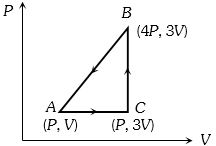
A sample of ideal monoatomic gas is taken round the cycle $ABCA$ as shown in the figure. The work done during the cycle is
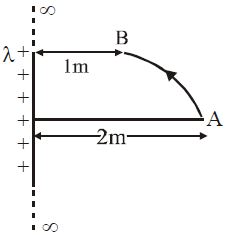
Figure shows a positively charged infinite wire. $A$ particle of charge $2C$ moves from point $A$ to $B$ with constant speed. (Given linear charge density on wire is $\lambda = 4 \pi \varepsilon_0$)
A particle of mass $10\, g$ is kept on the surface of a uniform sphere of mass $100\, kg$ and radius $10\, cm$. Find the work to be done against the gravitational force between them to take the particle far away from the sphere $($you may take $G = 6.67 \times 10^{-11}\, Nm^2 / kg^2)$
The given truth table is of
$A$ $X$
$0$ $1$
$1$ $0$
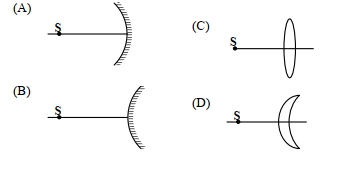
An optical component and an object $S$ placed along its optic axis are given in Column $I$. The distance between the object and the component can be varied. The properties of images are given in Column $II$. Match all the properties of images from Column $II$ with the appropriate components given in Column $I$. Indicate your answer by darkening the appropriate bubbles of the $4 \times 4$ matrix given in the $ORS$.
Column $I$ Column $II$
$Image$ $(p)$ Real image
$Image$ $(q)$ Virtual image
$Image$ $(r)$ Magnified image
$Image$ $(s)$ Image at infinity

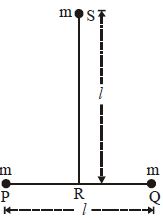
Two particles each of mass $m$ are placed at points $P$ and $Q$ as shown in the figure. $R$ is the mid-point of $PQ = l$. The gravitational force on the third particle of mass $m$ placed at point $S$ on the perpendicular bisector of $PQ$ is
A thin oil layer floats on water. A ray of light making an angle of incidence of $40^o $ shines on oil layer. The angle of refraction of light ray in water is......$^o$

(${\mu _{oil}} = 1.45,\,{\mu _{water}} = 1.33$)

Consider the circuit shown in the figure below. All the resistors are identical. The charge stored in the capacitor, once it is fully charged is