MCQ
$Assertion$ : When a particle moves in a circle with a uniform speed, its velocity and acceleration both changes.

$Reason$ : The centripetal acceleration in circular motion is dependent on angular velocity of the body.

  • A
    If both Assertion and Reason are correct and the Reason is a correct explanation of the Assertion.
  • If both Assertion and Reason are correct but Reason is not a correct explanation of the Assertion.
  • C
    If the Assertion is correct but Reason is incorrect.
  • D
    If both the Assertion and Reason are incorrect.
Answer

Correct option: B.
If both Assertion and Reason are correct but Reason is not a correct explanation of the Assertion.
b
In uniform circular motion, the magnitude of velocity and acceleration remains same, but due to change in direction of motion, the direction of velocity and acceleration changes. Also the centripetal acceleration is given by $a = w^2r.$

Need a full question paper?

Generate a complete, print-ready paper with questions like this in minutes — across 16+ boards, with answer keys.

Start Generating Free

Similar questions

Acceleration due to gravity at surface of a planet is equal to that at surface of earth and density is $1.5$ times that of earth. If radius of earth is $R$, radius of planet is .................
Consider an ideal gas confined in an isolated closed chamber. As the gas undergoes an adiabatic expansion, the average time of collision between molecules increases as $V ^q$, where $V$ is the volume of the gas. The value of $q$ is $\left( {\gamma = \frac{{{C_P}}}{{{C_V}}}} \right)$
If a stone is released from a ballon rising with acceleration $a$ at the instant when its velocity is $v$, then immediately after release, the acceleration and velocity of the stone are
A sphere $P$ of mass $m$ and moving with velocity $v$ undergoes an oblique and perfectly elastic collision with an identical sphere $Q$ initially at rest. The angle $\theta $ between the velocities of the spheres after the collision shall be ............... $^o$
A vessel is filled with an ideal gas at a pressure of $10$ atmospheres and temperature ${27}^\circ C$. Half of the mass of the gas is removed from the vessel and temperature of the remaining gas is increased to ${87}^\circ C$. Then the pressure of the gas in the vessel will be ...... $atm$
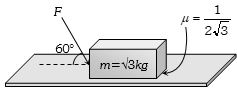
What is the maximum value of the force $F$ such that the block shown in the arrangement, does not move ........ $N$
A cylinder of $5$ litre capacity, filled with air at $N.T.P.$ is connected with another evacuated cylinder of $30$ litres of capacity. The resultant air pressure in both the cylinders will be ...... $cm$ of $Hg$
Dimensions of charge are
A constant volume gas thermometer shows pressure reading of $50 \,cm$ and $90 \,cm$ of mercury at $0^{\circ} C$ and $100^{\circ} C$ respectively. When the pressure reading is $60 \,cm$ of mercury, the temperature is ......... $^{\circ} C$
The molecular kinetic energy of a liquid is: