Question
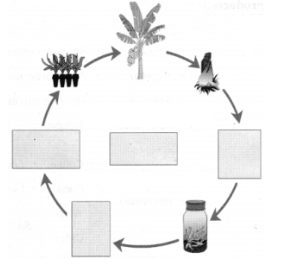
Assign names in the figure given below. Explain the various stages those are kept blank:
Image

Answer


Image

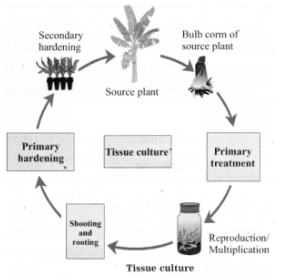
Tissue Culture: Tissue culture is the technique in which ‘ex vivo growth of cells or tissues in an aseptic and nutrient-rich medium’ is done. While performing experiments of tissue culture, a liquid, solid or gel-like ” medium prepared from agar, is used. Such medium supplies nutrients and energy necessary for tissue culture technique. Different processes are to be done while performing tissue culture, viz. primary treatment, reproduction or multiplication, shooting and rooting, primary hardening, secondary hardening, etc. From the source plant, required tissues are taken out and all the processes are carried in an aseptic medium in laboratory.

Need a full question paper?

Generate a complete, print-ready paper with questions like this in minutes — across 16+ boards, with answer keys.

Start Generating Free

Similar questions

An element X belongs to group 2 and another element Y belongs to group 15 of the periodic table:
  1. What is the number of valence electrons in X?
  2. What is the valency of X?
  3. What is the number of valence electrons in Y?
  4. What is the valency of Y? Explain how you have arrived at your answers.
You are given three resistances of 1,2 and 3 ohms. Show by diagrams, how with the help of these resistances you can get:
  1. $6\Omega$
  2. $\frac{6}{11}\Omega$
  3. $1.5\Omega$
Name the products of combustion of fossil fuels like coal and petroleum products. How do they affect us and our environment?
An organic compound $A ($molecular formula $C_2H_4O_2)$ reacts with Na metal to form a compound $B$ and evolves a gas which burns with a pop sound. Compound $A$ on treatment with an alcohol $C$ in the presence of a little of concentrated sulphuric acid forms a sweet-smelling compound $D ($molecular formula $C_3H_6O_2)$. Compound $D$ on treatment with NaOH solution gives back $B$ and $C.$ Identify $A, B, C$ and $D.$
What are macromolecules? Explain Natural and manmade macromolecule.
Explain Bayer’s process of concentration of bauxite with a chemical equation.
Which problems does the common man face due to incidence of cyber crime?
With the help of RNA, the genes present in the form of DNA participate in the functioning of cell and thereby control the structure and functioning of the body. Information about protein synthesis is stored in the DNA and synthesis of appropriate proteins as per requirement is necessary for body. These proteins are synthesized by DNA through the RNA. This is called ‘Central Dogma’. mRNA is produced as per the sequence of nucleotides on DNA. Only one of the two strands of DNA is used in this process. The sequence of nucleotides in mRNA being produced is always complementary to the DNA strand used for synthesis. Besides, there is uracil in RNA instead of thymine of DNA. This process of RNA synthesis is called ‘transcription’.
(1) Which part of the cell control the structure and functioning of the body?
(2) How is a specific protein synthesised in the cell?
(3) What is the similarity between mRNA and DNA?
(4) Give one difference between RNA and DNA.
(5) Define central dogma.
Mendeleev predicted the existence of certain elements not known at that time and named two of them as eka - aluminium, and eka - silicon.
  1. Name the element which has taken the place of $(i)$ eka - aluminium, and $(ii)$ eka - silicon.
  2. Mention the period/ periods of these elements in the modern periodic table.
  3. Write the group/ groups of these elements in the modern periodic table.
  4. Classify these elements as metals, non - metals or metalloids.
  5. How many valence electrons are present in the atoms of each of these elements$?​​​​​​$
How much energy will be available to hawks in the food chain comprising hawk, snake, paddy and mice, if 10,000 J of energy is available to paddy from the sun?