MCQ
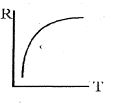
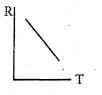
Assume a hypothetical wire in which free electron density changes with temperature in proportionality $n\ \alpha \ T$ assuming $\tau $(Relaxation time of collision) and dimensions of wire remain unchanged with increasing temperature. Which one of the resistance $v/s$ temperature graph is true

  • B

  • C

  • D

Answer

Correct option: A.

a
$R = \left( {\frac{{2lm}}{{{e^2}\tau A}}} \right)\frac{1}{n}$

Need a full question paper?

Generate a complete, print-ready paper with questions like this in minutes — across 16+ boards, with answer keys.

Start Generating Free

Similar questions

If you are provided three resistances 2 $\Omega$, 3 $\Omega$ and 6 $\Omega$. How will you connect them so as to obtain the equivalent resistance of 4 $\Omega$
$A$ thin lens with focal length $f$ to be used as a magnifying glass. Which of the following statements regarding the situation is true?
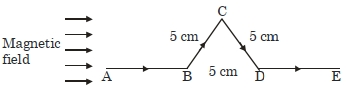
A triangular shaped wire carrying $10 A$ current is placed in a uniform magnetic field of $0.5\,T$, as shown in figure. The magnetic force on segment $CD$ is $....N$ $($ Given $BC = CD = BD =5\,cm )$.
The excess pressure inside a soap bubble is twice the excess pressure inside a second soap bubble. The volume of the first bubble is n times the volume of the second where n is:
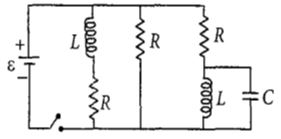
Figure shows a circuit that contains three identical resistors with resistance $R = 9.0 \,\,\Omega$ each, two identical inductors with inductance $L = 2.0\, mH$ each, and an ideal battery with $emf\,\, = 18 \,\,V.$ The current $i$ through the battery just after the switch closed is
Suppose a uniformly charged wall provides a uniform electric field of $2 \times 10^4 \mathrm{~N} / \mathrm{C}$ normally. A charged particle of mass $2 \mathrm{~g}$ being suspended through a silk thread of length $20 \mathrm{~cm}$ and remain stayed at a distance of $10 \mathrm{~cm}$ from the wall. Then the charge on the particle will be $\frac{1}{\sqrt{\mathrm{x}}} \ \mu \mathrm{C}$ where $\mathrm{x}=$ ____________.  use $g=10 \mathrm{~m} / \mathrm{s}^2$ ]
A wire of non-uniform cross-section is carrying a steady current. Along the wire
The rays parallel and close to the principal axis are called:
By photoelectric effect, Einstein, proved
A thermocouple is made of Cu and Fe. If a battery is connected in it, then