MCQ
At critical temperature, the surface tension of a liquid
  • A
    is zero
  • B
    is infinity
  • C
    cannot be determined
  • D
    is same as that any other temperature

Answer

(a) is zero
Explanation: At the critical temperature, the surface tension of a liquid becomes zero.

Need a full question paper?

Generate a complete, print-ready paper with questions like this in minutes — across 16+ boards, with answer keys.
Start Generating Free

Similar questions

When a longitudinal wave propagates through a medium, the particles of the medium execute simple harmonic oscillations about their mean positions. These oscillations of a particle are characterised by an invariant
A man is watching two trains, one leaving and the other coming with equal speed of $4\,m/s$. If they sound their whistles each of frequency $240\, Hz$, the number of beats per sec heard by man will be equal to (velocity of sound in air $= 320\, m/s$)
If $\vec{a}$ and $\vec{b}$ makes an angle $\cos ^{-1}\left(\frac{5}{9}\right)$ with each other, then $|\vec{a}+\vec{b}|=\sqrt{2}|\vec{a}-\vec{b}|$ for $|\vec{a}|=n|\vec{b}|$ The integer value of $n$ is . . . . . . .. 
$A$ system of $N$ particles is free from any external forces. Which of the following is true for the magnitude of the total momentum of the system?
Two cubes of size $1.0$ $m$ sides, one of relative density $0.60$ and another of relative density $=$ $1.15$ are connected by weightless wire and placed in a large tank of water. Under equilibrium the lighter cube will project above the water surface to a height of ........ $cm$
For a particle executing simple harmonic motion, which of the following statements is not correct
The gas law $\frac{{PV}}{T} = $ constant is true for
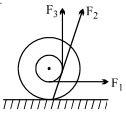
$A$ yo-yo is resting on a rough horizontal table. Forces $F_1, F_2$ and $F_3$ are applied separately as shown. The correct statement is
When length is increased on applying force, then strain is called:
A string of length $1\,\,m$ and linear mass density $0.01\,\,kgm^{-1}$ is stretched to a tension of $100\,\,N.$ When both ends of the string are fixed, the three lowest frequencies for standing wave are $f_1, f_2$ and $f_3$. When only one end of the string is fixed, the three lowest frequencies for standing wave are $n_1, n_2$ and $n_3$. Then