MCQ
At time $t=0$, a container has $N_{0}$ radioactive atoms with a decay constant $\lambda$. In addition, $c$ numbers of atoms of the same type are being added to the container per unit time. How many atoms of this type are there at $t=T$ ?
  • A
    $\frac{c}{\lambda} \exp (-\lambda  T)-N_0 \exp (-\lambda T)$
  • B
    $\frac{c}{\lambda} \exp (-\lambda T)+N_0 \exp (-\lambda T)$
  • $\frac{c}{\lambda}(1-\exp (-\lambda  T))+N_0 \exp (-\lambda T)$
  • D
    $\frac{c}{\lambda}(1+\exp (-\lambda T))+N_0 \exp (-\lambda T)$

Answer

Correct option: C.
$\frac{c}{\lambda}(1-\exp (-\lambda  T))+N_0 \exp (-\lambda T)$
c
(c)

Net decay rate of active nuclii is

$\frac{d N}{d t}=c-\lambda N$

$\Rightarrow \quad \frac{d N}{c-\lambda N}=d t$

Integrating both sides, we get

$\int \frac{d N}{c-\lambda N}=\int d t \quad \dots(i)$

Now, $\quad c-\lambda N=u$

Differentiating,

$-\lambda d N=d u$

above equation, we have

$d N=\frac{d x}{-\lambda} \quad \dots(i)$

Substituting is Eq. $(i)$, we get

$\frac{-1}{\lambda} \int \frac{d u}{u}=\int d t$

$\Rightarrow -\frac{1}{\lambda} \log u=t+k$

where, $k$ is constant of integration.

$\Rightarrow -\frac{1}{\lambda} \log (c-\lambda N)=t+k \quad \dots(ii)$ 

Now, at $t=0$ and $N=N_0$,

So, $\frac{-1}{\lambda} \log \left(c-\lambda N_{0}\right)=k$.

Substituting for $k$ in Eq. $(ii)$, we get

$-\frac{1}{\lambda} \log (c-\lambda N)=t-\frac{1}{\lambda} \log$

$\left(c-\lambda N_0\right)$

$\log \left(\frac{c-\lambda N}{c-\lambda N_{0}}\right)=-\lambda t$

Taking antilog we get,

$\frac{c-\lambda N}{c-\lambda N_0}=e^{-\lambda t}$

$\Rightarrow c-\lambda N=\left(c-\lambda N_0\right) e^{-\lambda t}$

Solving for $N$, we get

$\Rightarrow \quad N=\frac{c}{\lambda}\left(1-e^{-\lambda t}\right)+N_0 e^{-\lambda t}$
Need a full question paper?

Generate a complete, print-ready paper with questions like this in minutes — across 16+ boards, with answer keys.

Start Generating Free

Similar questions

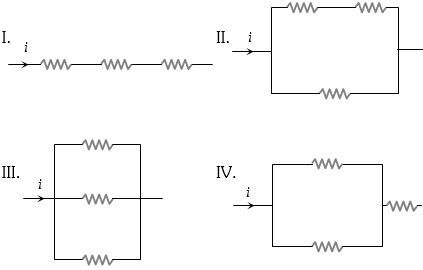
The three resistance of equal value are arranged in the different combinations shown below. Arrange them in increasing order of power dissipation.
There are ${n_1}$ photons of frequency ${\gamma _1}$ in a beam of light. In an equally energetic beam, there are ${n_2}$ photons of frequency ${\gamma _2}$. Then the correct relation is
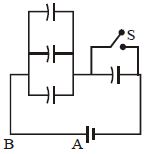
Four capacitors of capacitance $10\,mF$ and a battery of $200\,V$ are arranged as shown. How much charge will flow through $AB$ after the switch $S$ is closed .....$\mu C$
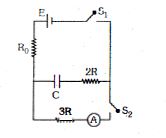
The capacitor $'C'$ is initially uncharged.  Switch $S_1$ is closed for a long time while $S_2$ remains open. Now at $t = 0$ , $S_2$ is closed while $S_ 1$ is opened. All the batteries are ideal and connecting wires are resistanceless. Find $INCORRECT$ statement
An $LCR$ circuit contains $R = 50\, \Omega$ ,$L =\,1 \,mH $ and $C = \,0.1$ $\mu F$. The impedance of the circuit will be minimum for a frequency of
If half life of a radioactive element is $3\, hours$, after $9\, hours$ its activity becomes
Assertion : For best contrast between maxima and minima in the interference pattern of Young’s double slit experiment, the intensity of light emerging out of the two slits should be equal.
Reason : The intensity of interference pattern is proportional to square of amplitude.
If ${n_e}$ and ${n_h}$ are the number of electrons and holes in a semiconductor heavily doped with phosphorus, then
When stopping potential is applied in an experiment on photoelectric effect, no photocurrent is observed. This means that:
The maximum number of possible interference maxima for slit-separation equal to twice the wavelength in Young’s double-slit experiment is