MCQ
Avalanche breakdown in a $PN$ junction diode is due to
  • A
    Sudden shift to Fermi level
  • B
    Increase in the width of forbidden gap
  • C
    Sudden increase of impurity concerntration
  • Cumulative effect of increased electron collision and creative of added electron hole pairs
Answer

Correct option: D.
Cumulative effect of increased electron collision and creative of added electron hole pairs
d
The avalanche breakdown in $p$$-n$ junction is due to cumulative effect of conduction band electron. In reverse bias, due to applied electric field, electrons acquire enough energy to free more electron bound to the atom.The abundant number of electron-hole pairs are created for conduction, this is cumulative effect.

Need a full question paper?

Generate a complete, print-ready paper with questions like this in minutes — across 16+ boards, with answer keys.

Start Generating Free

Similar questions

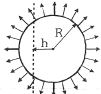
Consider a metal sphere of radius $R$ that is cut in two parts along a plane whose minimum distance from the sphere's centre is $h$. Sphere is uniformly charged by a total electric charge $Q$. The minimum force necessary to hold the two parts of the sphere together, is
A moving coil galvanometer can be converted into voltmeter by:
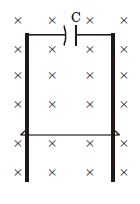
A wire of mass $m$ and length $l$ can slide freely on a pair of smooth, vertical rails (figure). A magnetic field $B$ exists in the region in the direction perpendicular to the plane of the rails. The rails are connected at the top end by a capacitor of capacitance $C$ . The acceleration of the wire neglecting any electric resistance is 
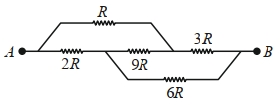
The equivalent resistance between $A$ and $B$ of the network shown in figure
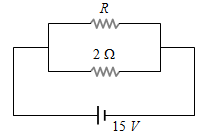
If in the circuit, power dissipation is 150 W, then R is
Two concave lenses $L_1$ and $L_2$ are kept in contact with each other. If the space between the two lenses is filled with a material of refractive index $\mu\approx1,$ the magnitude of the focal length of the combination:
The curve drawn between velocity and frequency of photon in vacuum will be a
On a glass plate a light wave is incident at an angle of $60^o $. If the reflected and the refracted waves are mutually perpendicular, the refractive index of material is
Two equal negative charges are fixed at the points $ [0, a ]$ and $[0, -a]$ on the $y-$ axis. A positive charge $Q$ is released from rest at the points $[2a, 0]$ on the $x-$axis . The charge $Q$ will
A current i passes through a wire of length l, radius of cross-section r and resistivity r. The rate of heat generation is