MCQ
Bartholinus discovered:
- AInterference by splitting the wave front
- BPolarisation by reflection
- CPolarisation by refraction
- DPolarisation by double refraction
Explanation:
In 1669, another Danish scientist, Erasmus Bartholinus discovered the polarization of light by double refraction in Iceland spar (calcite).
Generate a complete, print-ready paper with questions like this in minutes — across 16+ boards, with answer keys.
A parallel plate capacitor is first charged and then a dielectric slab is introduced between the plates. The quantity that remains unchanged is
|
(a) Charge Q |
(b) Potential V |
(c) Capacity C |
(d) Energy U |
What is the potential energy of the equal positive point charges of 1μC each held 1 m apart in air
|
(a) 9 |
(b) 9 |
(c) 2 eV/m |
(d) Zero |
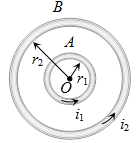
A and B are two concentric circular conductors of centre O and carrying currents  and
and  as shown in the adjacent figure. If ratio of their radii is 1 : 2 and ratio of the flux densities at O due to A and B is 1 : 3, then the value of
  is
is
|
(a) |
(b) |
(c) |
(d) |
Force between two identical bar magnets whose centres are r metre apart is 4.8 N, when their axes are in the same line. If separation is increased to 2r, the force between them is reduced to
|
(a) 2.4N |
(b) 1.2N |
(c) 0.6N |
(d) 0.3N |
The following four wires are made of the same material and are at the same temperature. Which one of them has highest electrical resistance
|
(a) Length = 50 cm, diameter = 0.5 mm |
(b) Length = 100 cm, diameter = 1 mm |
|
(c) Length = 200 cm, diameter = 2 mm |
(d) Length = 300 cm, diameter = 3 mm |
A current carrying coil is placed with its axis perpendicular to N-S direction. Let horizontal component of earth's magnetic field be Ho and magnetic field inside the loop is H. If a magnet is suspended inside the loop, it makes angle θ with H. Then θ =
|
(a) |
(b) |
(c) |
(d) |
$0$
$\delta$
$2\delta$
$3\delta$
The current in the given circuit is

|
(a) 8.31 A |
(b) 6.82 A |
(c) 4.92 A |
(d) 2 A |


