MCQ
Bernoulli's principle is related to:
  • A
    viscosity
  • B
    surface tension
  • flow of fluid
  • D
    molecular structure of liquids.

Answer

Correct option: C.
flow of fluid
C

Need a full question paper?

Generate a complete, print-ready paper with questions like this in minutes — across 16+ boards, with answer keys.
Start Generating Free

Similar questions

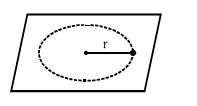
A small mass attached to a string rotates on a frictionless table top as shown. If the tension in the string is increased by pulling the string cauusing the radius of the circular motion to decrease by a factor of $2$ , the kinetic energy of the mass will
Match List $I$ with List $II$ :

List $I$ List $II$
$A$ Isothermal Process $I$ Work done by the gas decreases internal energy
$B$ Adiabatic Process $II$ No change in internal energy
$C$ Isochoric Process $III$ The heat absorbed goes partly to increase internal energy and partly to do work
$D$ Isobaric Process $IV$ No work is done on or by the gas

Choose the correct answer from the options given below :
A particle is moving with constant speed $\sqrt 2\,m/s$ on a circular path of radius $10\,cm$. Find the magnitude of average velocity when it has covered ${\left( {\frac{3}{4}} \right)^{th}}$ circular path
When a longitudinal wave propagates through a medium, the particles of the medium execute simple harmonic oscillations about their mean positions. These oscillations of a particle are characterised by an invariant
A particle of mass $m$ is moving along a trajectory given by
$x = x_0 + a\, cos\,\omega_1 t$
$y = y_0 + b\, sin\,\omega_2t$
The torque, acing on the particle about the origin, at $t = 0$ is
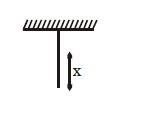
A wire of variable mass per unit length $\mu = \mu _0x$ , is hanging from the ceiling as shown in figure. The length of wire is $l_0$ . A small transverse disturbance is produced at its lower end. Find the time after which the disturbance will reach to the other ends
A man spinning in free space changes the shape of his body e.g. by stretching his arms or curling up then, which of the following physical quantity will remain constant:
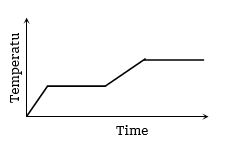
Heat is supplied to a certain homogenous sample of matter, at a uniform rate. Its temperature is plotted against time, as shown. Which of the following conclusions can be drawn
The displacement of a particle is represented by the following equation $s = 2t^3 + 7t^2 + 5t + 8$ where $s$ is in metres and $t$ in seconds. The acceleration of the particle at $t = 1\ s$ is:
A bob of mass $m$, suspended by a string of length $I_1$, is given a minimum velocity required to complete a full circle in the vertical plane, At the highest point, it collides elastically with another bob of mass $m$ suspended by a string of length $I_2$, which is initially at rest. Both the strings are mass-less and inextensible. If the second bob, after collision acquires the minimum speed required to complete a full circle in the vertical plane, the ratio $\frac{I_1}{I_2}$ is :