MCQ
Boyle' law is applicable for an:
  • Isothermal process
  • B
    Isochoric process
  • C
    Adiabatic process
  • D
    Isobaric process

Answer

Correct option: A.
Isothermal process

Need a full question paper?

Generate a complete, print-ready paper with questions like this in minutes — across 16+ boards, with answer keys.

Start Generating Free

Similar questions

A standing wave is formed by the superposition of two waves travelling in opposite directions. The transverse displacement is given by $y\left( {x,t} \right) = 0.5\sin\, \left( {\frac{{5\pi }}{4}x} \right)\,\cos\, \left( {200\,\pi t} \right)$. What is the speed of the travelling wave moving in the positive $x$ direction .... $m/s$ ? ($x$ and $t$ are in meter and second, respectively.)
Suppose all the surfaces in the previous problem are rough. The direction of friction on $B$ due to $A:$
A particle of mass m is executing oscillations about the origin on the $X-$axis. Its potential energy is $U(x) = k{[x]^3}$, where $k$ is a positive constant. If the amplitude of oscillation is $a$, then its time period $T$ is
$A$ slender uniform rod of length $\lambda$ is balanced vertically at a point $P$ on a horizontal surface having some friction. If the top of the rod is displaced slightly to the right, the position of its centre of mass at the time when the rod becomes horizontal :
The two gases with the ratio $3 : 2$ of their masses in a container are at a temperature $T.$ The ratio of the kinetic energies of the molecule of two gases is:
If a particle moves in a circle describing equal angles in equal times, its velocity vector
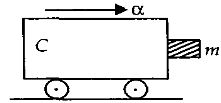
A block of mass $m$ is in contact with the cart $C$ as shown in the figure. The coefficient of static friction between the block and the cart is $\mu .$ The acceleration $\alpha$ of the cart that will prevent the block from falling satisfies
Choose the correct alternatives:
  1. For a general rotational motion, angular momentum $L$ and angular velocity $\omega$ need not be parallel.
  2. For a rotational motion about a fixed axis, angular momentum $L \omega$ are always parallel.
  3. For a general translational motion , momentum $P$ and velocity $v$ are aways parallel.
  4. For a general translational motion, acceleration $a$ and velocity $v$ are always parallel.
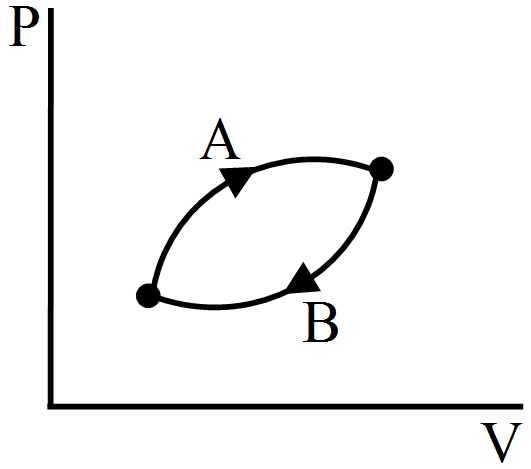
Refer to figure. Let $\Delta\text{U}_1$ and $\Delta\text{U}_2$ be the change in internal energy in processes $A$ and $B$ respectively, $\Delta\text{Q}$ be the net heat given to the system in process $A + B$ and $\Delta \text{W}$ be the net work done by the system in the process $A + B.$
  1. $\Delta\text{U}_1+\Delta\text{U}_2=0$
  2. $\Delta\text{U}_1-\Delta\text{U}_2=0$
  3. $\Delta\text{Q}-\Delta\text{W}=0$
  4. $\Delta\text{Q}+\Delta\text{W}=0$
Two stretched membranes of area $2\, cm^2$ and $3\, cm^2$ are placed in a liquid at the same depth. The ratio of pressures on them is