Question
Briefly describe the following: Translation

Answer

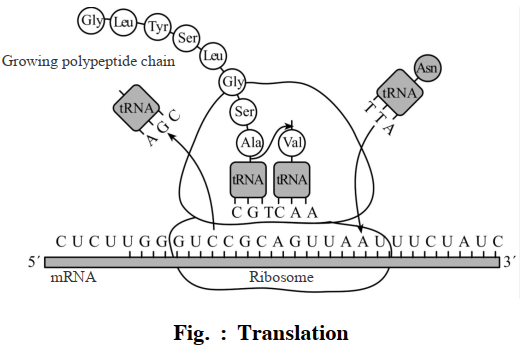
Translation: The formation of a poly-peptide chain from m-RNA is known as Translation. All three types of RNAs named m-RNA, r-RNA and t-RNA participate in this process. The process of translation takes place on ribosome. The sequence of three nitrogen bases present in 5-3 direction on m-RNA is called genetic code. This code determines the sequence of amino acids in a poly-peptide chain. t-RNA has anticodon which brings specific amino acid from cytoplasm tom-RNA and this entire process requires energy provided by ATP.
The process of translation is completed in following steps:
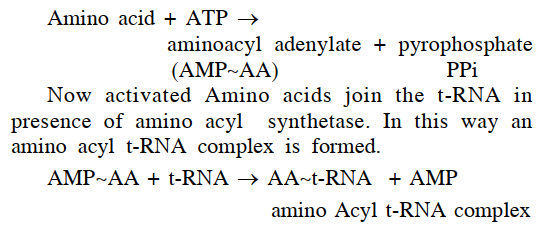
Activation of amino acids: All the 20 types of amino acids are present in cytoplasm in inactive state but before joining to t-RNA, amino acids become active to react with ATP in presence of $Mg ^{++}$ and amino acyl t-RNA synthetase. The activated amino acids are called amino acyl adenylate.
Image
Involvement of Ribosome: Ribosomes are composed of Protein and r-RNA. These ribosomes are made of two dissimilar (smaller and bigger) subunits which join together at the time of protein synthesis along with m RNA. Many ribosomes unite together forming Polyribosome which takes part in this process.
Initiation of poly-peptide chain formation: Each poly-peptide chain always begins with meithionine amino acid. This amino acid is coded by initiating codon AUG. The t-RNA possessing this amino acid has anti codon UAC. Therefore t-RNA with anti-codon UAC and activated methionine amino acid joins the m-RNA with codon AUG and initiates the synthesis of poly-peptide chain. This process requires the GTP bound with bigger sub-unit of ribosome and initiation factors like $IF _1$, $IF _2$ and $IF _3$ During translation, m RNA contains the sequences which has initiation codon AUG at one end and termination codon at other end. Ribosome binds at 5' end of m RNA and translates codons in m RNA on moving towards 3' end. m-RNA has some additional sequences which are not translated such sequences are said to be untranslated region or UTR. These UTR are very essential for effective translation and are situated before initiation. codon at 5' and after terms nation codon at 3'.
Formation and elongation of poly-peptide chain:
Amino acid in poly-peptide chain are joined together by peptide linkage. This linkage is formed between carboxyl group (-COOH) of one amino acid and an amine group $\left(- NH _2\right)$of next amino acid. The carboxyl group of chain initiating amino acid meithionine remains free to form linkage with - $- NH _2$group of next amino acid.
Now the next activated t-RNA with an appropriate anticodon (that is complementary to codon of m RNA) and amino acid combines with the code of m RNA at A-site. Peptide-linkage is formed between successive amino acids in presence of peptidyl transferase m-RNA moves forward at P site/D-site and A site is occupied by new codon. Now next t-RNA molecule with amino acid reaches the A Site and repeats the same process resulting in elongation of poly peptide chain. The shifting of m RNA from A-site to P-site is called translocation.
Image
Termination of poly peptide chain: The elongation continues till the whole m RNA is translated and a signal in the form of termination codon is reached for which t-RNA has no anticodon such codon are called nonsense codon or stop codon or termination cordons e.g. UAA, UAG and UGA Releasing factors $R _2$ and $R _3$ are helpful in this process which makes polypeptide chain to be free. After becoming free, polypeptide chain undergoes some changes. Enzyme formylase separates the former group of first-amino acid methionine. Some amino acid can be removed from beginning or ending side of chain. After this chain becomes folded to form secondary or tertiary structure. This entire process takes energy from GTP.

Need a full question paper?

Generate a complete, print-ready paper with questions like this in minutes — across 16+ boards, with answer keys.

Start Generating Free

Similar questions

Describe the logistic population growth.
What is decomposition? Describe the decomposition cycle in a terrestrial ecosystem. Assist your answer with diagramatic representation.
(i) Explain the amino acylation process of tRNA and describe its role in the translation process.
(ii) How does the translation process start in prokaryotes (infinite nuclei)? Describe.
(iii) Where are the untranslated regions located in m-RNA and why?
Explain the development of a secondary oocyte (ovum) in a human female from the embryonic stage upto its ovulation. Name the hormones involved in this process.

OR

When does oogenesis start in humans? Name the three hormones and their sources, linked with oogenesis. How do they influence the process of oogenesis? Explain.

  1. What is “population” according to you as a biology student?
  2. “The size of a population for any species is not a static parameter.” Justify the statement with specific reference to fluctuations in the population density of a region in a given period of time.
One of the main objectives of biotechnology is to minimise the use of insecticides on cultivated crops. Explain with the help of a suitable example how insect resistant crops have been developed using techniques of biotechnology.
Draw a neat diagram of the female reproductive system and label the parts associated with the following.
  1. Production of gamete.
  2. Site of fertilisation.
  3. Site of implantation.
  4. Birth canal.
Answer the following questions:
Explain the hormonal regulation of the process of spermatogenesis in humans.
Why are drugs misused by players? Describe the side effects of these drugs.
Read the following and answer any four questions from (i) to (v) given below:

Crown gall is a neoplastic disease of most dicotyledonous plants and is caused by the soil bacterium Agrobacterium tumefaciens. A large extra chromosomal plasmid in these bacteria was found to be responsible for this disease. The plasmid is known as Ti plasmid. Bacteria free crown gall cells can be cultured in the absence of phytohormones. Ti plasmid is widely used in genetic engineering to deliver the desirable genes. The part of Ti plasmid transferred into plant cell DNA is called T-DNA. T-DNA with desired DNA segment is inserted into the chromosome of the host plant where it produces copies of itself.

  1. Which of the following is the full full of T-DNA?
  1. Transfer DNA.
  2. Tumour inducing DNA.
  3. Transgenic DNA.
  4. None of these.
  1. Ti plasmid cannot infect and develop crown gall in,
  1. Tomato.
  2. Maize.
  3. Soybean.
  4. sunflower.
  1. While making transgenic plant, T-DNA is inserted into the host cell, it is then:
  1. Integrated into the target host genome.
  2. Lie independent of the host genome.
  3. Rupture the host cell wall.
  4. Produce oncogenic factors in the host.
  1. Agrobacterium mediated gene transfer in plants:
  1. Allows relatively large segment of DNA.
  2. Transfer of DNA with defined ends and minimal rearrangement.
  3. High quality and fertility in transgenic plants.
  4. All of these.
  1. Assertion: In Agrobacterium mediated gene transfer in plants, transgenic plants do not develop tumors.

Reason: In T-DNA tumor producing genes are deleted during the process of gene transfer.
  1. Both assertion and reason are true and reason is the correct explanation of assertion.
  2. Both assertion and reason are true but reason is not the correct explanation of assertion.
  3. Assertion is true but reason is false.
  4. Both assertion and reason are false.