MCQ
Bulk modulus was first defined by
  • A
    Young
  • B
    Bulk
  • Maxwell
  • D
    None of the above

Answer

Correct option: C.
Maxwell
c
(c) Bulk modulus was first defined by maxwell

Need a full question paper?

Generate a complete, print-ready paper with questions like this in minutes — across 16+ boards, with answer keys.

Start Generating Free

Similar questions

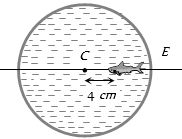
In a thin spherical fish bowl of radius $10 \,cm$ filled with water of refractive index $\left( {\mu = \frac{4}{3}} \right)$ there is a small fish at a distance of $4\, cm$ from the centre $C$ as shown in figure. Where will the image of fish appears, if seen from $E$.....$cm$
The $\beta$-decay process, discovered around $1900$ , is basically the decay of a neutron ( $n$ ), In the laboratory, a proton ( $p$ ) and an electron ( $e ^{-}$) are observed as the decay products of the neutron. therefore, considering the decay of a neutron as a tro-body dcay process, it was predicted theoretically that thekinetic energy of the electron should be a constant. But experimentally, it was observed that the electron kinetic energy has a continuous spectrum. Considering a three-body decay process, i.e. $n \rightarrow p+ e ^{-}+\bar{v}_{ e }$, around $1930,$ Pauli explained the observed electron energy spectrum. Assuming the anti-neutrino $\left(\bar{v}_{ e }\right)$ to be massless and possessing negligible energy, and neutron to be at rest, momentum and energy conservation principles are applied. From this calculation, the maximum kinetic energy of the lectron is $0.8 \times 10^6 eV$. The kinetic energy carried by the proton is only the recoil energy.

$1.$ What is the maximum energy of the anti-neutrino?

$(A)$ Zero

$(B)$ Much less than $0.8 \times 10^6 \ eV$

$(C)$ Nearly $0.8 \times 10^6 \ eV$

$(D)$ Much larger than $0.8 \times 10^6 \ eV$

$2.$ If the anti-neutrino had a mass of $3 eV / c ^2$ (where $c$ is the speed of light) instead of zero mass, what should be the range of the kinetic energy, $K$, of the electron?

$(A)$ $0 \leq K \leq 0.8 \times 10^6 \ eV$

$(B)$ $3.0 eV \leq K \leq 0.8 \times 10^6 \ eV$

$(C)$ $3.0 eV \leq K < 0.8 \times 10^6 \ eV$

$(D)$ $0 \leq K < 0.8 \times 10^6 \ eV$

Give the answer question $1$ and $2.$
A projectile is projected with kinetic energy $K$. If it has the maximum possible horizontal range, then its kinetic energy at the highest point will be ......... $K$
For an ideal gas, the internal energy is given by $U=5 p V / 2+C$, where $C$ is a constant. The equation of the adiabats in the $p V$-plane will be
A chimpanzee swinging on a swing in a sitting position, stands up suddenly, the time period will
A charge $Q$ is placed at each of the opposite corners of a square. A charge $q$ is placed at each of the other two corners. If the net electrical force on $Q$ is zero, then  $\frac{Q}{q}=$ ______
$P_i, V_i$ and $P_f$, $V_f$ are initial and final pressures and volumes of a gas in a thermodynamic process respectively. If $PV^n =$ constant, then the amount of work done is 
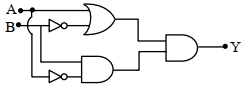
The output $\mathrm{Y}$ of following circuit for given inputs is :
Suppose a uniformly charged wall provides a uniform electric field of $2 \times 10^4 \mathrm{~N} / \mathrm{C}$ normally. A charged particle of mass $2 \mathrm{~g}$ being suspended through a silk thread of length $20 \mathrm{~cm}$ and remain stayed at a distance of $10 \mathrm{~cm}$ from the wall. Then the charge on the particle will be $\frac{1}{\sqrt{\mathrm{x}}} \ \mu \mathrm{C}$ where $\mathrm{x}=$ ____________.  use $g=10 \mathrm{~m} / \mathrm{s}^2$ ]
The magnitude of the centripetal force acting on a body of mass $m$ executing uniform motion in a circle of radius $r$ with speed $v$ is