MCQ
By a surface of a liquid we mean.
  • A
    $A$ geometrical plane like $x = 0$
  • B
    All molecules exposed to the atmosphere.
  • $A$ layer of thickness of the order of $10^{-8}m.$
  • D
    $A$ layer of thickness of the order of $10^{-4}m.$

Answer

Correct option: C.
$A$ layer of thickness of the order of $10^{-8}m.$
The surface of a liquid refers to the layer of molecules that have higher potential energy than the bulk of the liquid.
This layer is typically $10$ to $15$ times the diameter of the molecule.
Now, the size of an average molecule is around $1nm = 10^{-9}m$ so a diameter of $10$ to $15$ times would be of order$, 10 \times 10^{-9} = 10^{-8}m.$

Need a full question paper?

Generate a complete, print-ready paper with questions like this in minutes — across 16+ boards, with answer keys.
Start Generating Free

Similar questions

Li nucleus has three protons and four neutrons. Mass of lithium nucleus is 7.03.6005 amu. Mass of proton is 1.007277 amu and mass of neutron is 1.008665 amu. Mass defect for lithium nucleus in amu is:
The magnifying power of a simple microscope can be increased, if we use eye-piece of(a) Higher focal length(b) Smaller focal length(c) Higher diameter(d) Smaller diameter  
   
   
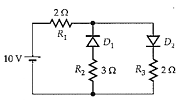
The given circuit has two ideal diodes connected as shown in the figure below. The current flowing through the resistance $R _1$ will be
Image
Consider the two idealized systems: (i) a parallel plate capacitor with large plates and small separation and (ii) a long solenoid of length L > > R, radius of cross-section. In (i) E is ideally treated as a constant between plates and zero outside. In (ii) magnetic field is constant inside the solenoid and zero outside. These idealised assumptions, however, contradict fundamental laws as below:
Two straight parallel wires, both carrying $10$ ampere in the same direction attract each other with a force of $1\times 10^{-3}N$. If both currents are doubled, the force of attraction will be
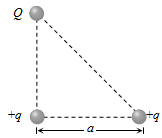
Three charges $Q, +q$ and $+q$ are placed at the vertices of a right$-$angled isosceles triangle as shown. The net electrostatic energy of the configuration is zero if $Q$ is equal to
A lightning arrester must have the following property.
In Geiger-Marsden scattering experiment, the trajectory traced by an a-particle depends on:
At a certain distance from a point charge the electric field is 500 V/m  and the potential is 3000 V. What is this distance(a) 6 m(b) 12 m(c) 36 m  (d) 144 m
       
Ten grams of $^{57}Co$ kept in an open container beta$-$decays with a half$-$life of $270$ days. The weight of the material inside the container after $540$ days will be very nearly: