MCQ
Two straight parallel wires, both carrying $10$ ampere in the same direction attract each other with a force of $1\times 10^{-3}N$. If both currents are doubled, the force of attraction will be
  • A
    $1\times 10^{-3}N$
  • B
    $2 \times 10^{-3}N$
  • $4 \times 10^{-3}N$
  • D
    $0.25 \times 10^{-3}N$ 

Answer

Correct option: C.
$4 \times 10^{-3}N$
$4 \times 10^{-3}N$

Need a full question paper?

Generate a complete, print-ready paper with questions like this in minutes — across 16+ boards, with answer keys.

Start Generating Free

Similar questions

Angular width of central maxima in the Fraunhoffer diffraction pattern of a slit is measured. The slit is illuminated by light of wavelength 6000 Å. When the slit is illuminated by light of another wavelength, the angular width decreases by 30%. The wavelength of this light will be(a) 6000 Å(b) 4200 Å(c) 3000 Å(d) 1800 Å
       
In Bohr's model of hydrogen atom, let PE represents potential energy and TE the total energy. In going to a higher level(a) PE decreases, TE increases(b) PE increases, TE increases(c) PE decreases, TE decreases(d) PE increases, TE decreases
   
   
Two charges $+5 \mu C$ and $+10 \mu C$ are placed 20 cm apart. The net electric field at the mid-Point between the two charges is
Solid targets of different elements are bombarded by highly energetic electron beams. The frequency $(f)$ of the characteristic $X-$rays emitted from different targets varies with atomic number $Z$ as
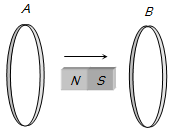
In the diagram shown if a bar magnet is moved along the common axis of two single turn coils $A$ and $B$ in the direction of arrow
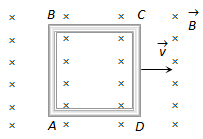
A conducting square loop of side $L$ and resistance $R$ moves in its plane with a uniform velocity $v$ perpendicular to one of its sides. A magnetic induction $B$ constant in time and space, pointing perpendicular and into the plane of the loop exists everywhere. The current induced in the loop is
Two spherical conductors each of capacity $C$ are charged to potentials $V$ and $– V.$ These are then connected by means of a fine wire. The loss of energy will be
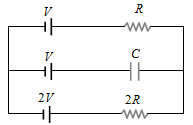
In the given circuit, with steady current, the potential drop across the capacitor must be
A convex lens(a) Converges light rays(b) Diverges light rays(c) Form real images always(d) Always forms virtual images
   
   
An ionised H-molecule consists of an electron and two protons. The protons are separated by a small distance of the order of angstrom. In the ground state: