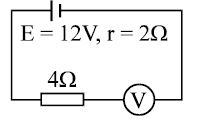
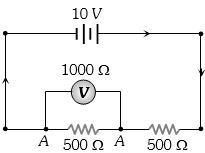
By error, a student places moving-coil voltmeter $V$ (nearly ideal) in series with the resistance in a circuit in order to read the current, as shown. The voltmeter reading will be ............ $V$
Medium
Download our app for free and get started
So if connected in series, a very small current will flow or no current will flow. An ideal voltmeter draws $0$ current from the circuit. So when we arrange it in series, It doesn't work as a voltmeter but as resistance and also the reading is shown by the voltmeter is the voltage across its terminals.
The voltmeter reading will be $12 V$.

Download our appand get started for free
Experience the future of education. Simply download our apps or reach out to us for more information. Let's shape the future of learning together!No signup needed.*
Similar Questions
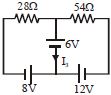
- 1Consider the circuit shown in the figure. The current $I_3$ is equal toView Solution
- 2A charged particle having drift velocity of $7.5 \times 10^{-4}\, ms ^{-1}$ is an electric field of $3 \times 10^{-10}\, Vm ^{-1}$ has a mobility in $m ^{2} V ^{-1} s ^{-1}$ ofView Solution
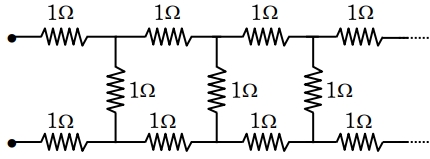
- 3View SolutionThe equivalent resistance of the infinite network given below is :
- 4View SolutionIn a metallic conductor, under the effect of applied electric field, the free electrons of the conductor
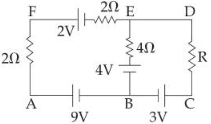
- 5In the electric network shown, when no current flows through the $4\, \Omega $ resistor in the arm $EB$, the potential difference between the points $A$ and $D$ will be ............... $V$View Solution
- 6What is the reading of voltmeter in the following figure .............. $V$View Solution
- 7A copper wire of diameter $1.02\, mm$ carries a current of $1.7\, amp$. Find the drift velocity $(v_d)$ of electrons in the wire. Given $n$, number density of electrons in copper $= 8.5 \times 10^{27} /m^3$....................... $mm/sec$View Solution
- 8The resistance of the series combination of two resistance is $S$. When they are joined in parallel the total resistance is $P$. If $S = nP$, then the minimum possible value of $n$ isView Solution
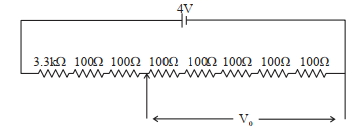
- 9A potential divider circuit is shown in figure. The output voltage $V_0$ isView Solution
- 10Find the net emf of the three batteries shown in figure ................ $\mathrm{V}$View Solution