MCQ
By graphical method, the solution of linear programming problem
Maximize Z = 3x1 + 5x2
Subject to
3x1 + 2x2 ≤ 18
x1 ≤ 4
x2 ≤ 6
x1 ≥ 0, x2 ≥ 0, is:
    • A
      x1 = 2, x2 = 0, Z = 6
    • B
      x1 = 2, x2 = 6, Z = 36
    • C
      x1 = 4, x2 = 3, Z = 27
    • D
      x1 = 4, x2 = 6, Z = 42

    Answer

    1. x1 = 2, x2 = 6, Z = 36

    Solution:

    We need to maximize the function Z = 3x4 + 5x2

    First, we will convert the given inequations into equations, we obtain the following equations:

    3x1 + 2x2 = 18, x1 = 4, x2 = 6, x1 = 0 and x2 = 0

    Region represented by 3x1 + 2x2 ≤ 18:

    The line 3x1 + 2x2 = 18 meets the coordinate axes at A(6, 0) and B(0, 9) respectively.

    By joining these points we obtain the line 3X1 + 2x2 = 18.

    Clearly (0, 0) satisfies the inequation 3x1 + 2x2 = 18.

    So the region in the plane which contain the origin represents the solution set of the inequation 3x1 + 2x2 ≤ 18.

    Region represented by x1 ≤ 4:

    The line x1 = 4 is the line that passes through C(4, 0) and is parallel to the Y axis.

    The region to the left of the line x1 = 4 will satisfy the inequation x1 ≤ 4.

    Region represented by x2 ≤ 6:

    The line x2 = 6 is the line that passes through D(0, 6) and is parallel to the X axis.

    The region below the line x2 = 6 will satisfy the inequation X2 ≤ 6.

    Region represented by x1 ≥ 0 and x2 ≥ 0:

    Since, every point in the first quadrant satisfies these inequations.

    So, the first quadrant is the region represented by the inequations x1 ≥ 0 and x2 ≥ 0.

    The feasible region determined by the system of constraints, 3x1 + 2x2 ≤ 18, x1 ≤ 4, x2 ≤ 6, x1 ≥ 0 and x2 ≥ 0 are as follows
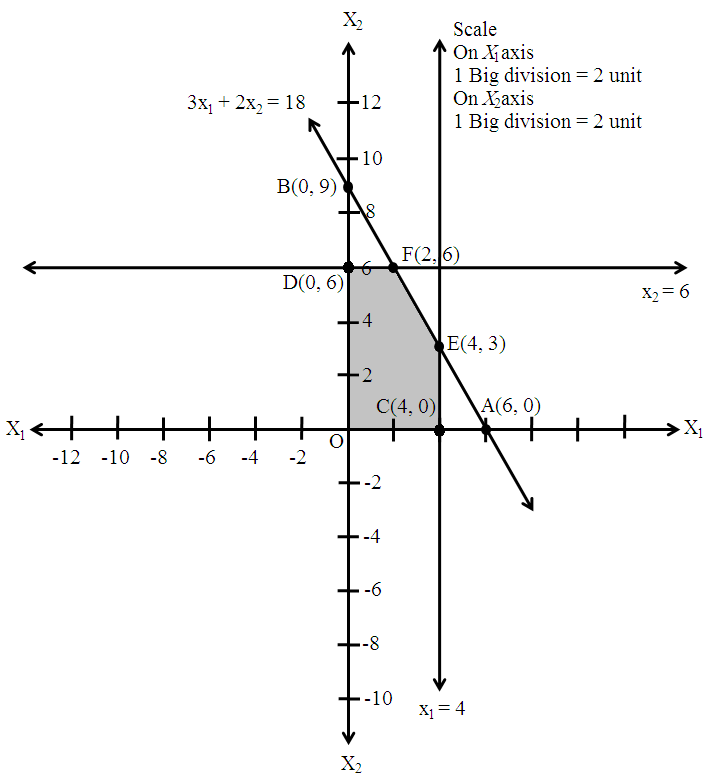
    Corner points are O(0, 0), D(0, 6), F(2, 6), E(4, 3) and C(4, 0).

    The values of the objective function at these points are given in the following table.

    Points
    Value of Z
    O(0, 0)
    3(0) + 5(0) = 0
    D(0, 6)
    3(0) + 5(6) = 30
    F(2, 6)
    3(2) + 5(6) = 36
    E(4, 3)
    3(4) + 5(3) = 27
    C(4, 0)
    3(4) + 5(0) = 12

    We see that the maximum value of the objective function Z is 36 which is at F(2, 6).

    Need a full question paper?

    Generate a complete, print-ready paper with questions like this in minutes — across 16+ boards, with answer keys.

    Start Generating Free

    Similar questions

    If $\big|\vec{\text{a}}\times\vec{\text{b}}\big|=4,\big|\vec{\text{a}}.\vec{\text{b}}\big|=2,$ then $|\vec{\text{a}}|^2\big|\vec{\text{b}}\big|^2=$
    1. 6
    2. 2
    3. 20
    4. 8
    If $\text{f}(\text{x})=\text{e}^{\cos^{-1}\big\{\sin\big(\text{x}+\frac{\pi}{3}\big)\big\}}$ then $\text{f}\Big(\frac{8\pi}{9}\Big)=$
    1. $\text{e}^{\frac{5\pi}{18}}$
    2. $\text{e}^{\frac{13\pi}{18}}$
    3. $\text{e}^{\frac{-2\pi}{18}}$
    4. $\text{none of these}$
    The value of $\int_\pi ^{2\pi } {[2\sin x]\,dx,} $ where $[\,\,.\,\,]$ represents the greatest integer function, is
    The equation of motion of a stone, thrown vertically upwards is $s = ut - 6.3{t^2},$ where the units of $s $ and $t $ are $cm$ and $sec.$ If the stone reaches at maximum height in $3$ sec, then  $u  =$ ......... $cm/\sec $
    The line y = mx bisects the area enclosed by lines $\text{x}=0,\text{y}=0$  and $\text{x}=\frac{3}{2}$ and the curve $\text{y}=1+4\text{x}-\text{x}^2.$  Then the value of m is:
    1. $\frac{13}{6}$
    2. $\frac{13}{2}$
    3. $\frac{13}{5}$
    4. $\frac{13}{7}$
    If $\int_0^{\frac{\pi}{4}} \frac{\sin ^2 x}{1+\sin x \cos x} d x=\frac{1}{a} \log _e\left(\frac{a}{3}\right)+\frac{\pi}{b \sqrt{3}}$, where a, $\mathrm{b} \in \mathrm{N}$, then $\mathrm{a}+\mathrm{b}$ is equal to ....................
    If $a = (2,\,\,5)$ and $b = (1,\,\,4),$ then the vector parallel to $(a + b)$ is
    A bag containe 5 black, 4white balls and 3 red balls. if a ball is selected randomwise, the probability that it is black or red ball is,
    1. $\frac{1}{3}$
    2. $\frac{1}{4}$
    3. $\frac{5}{12}$
    4. $\frac{2}{3}$
    The area bounded by $y = x^2 + 2$ and $y = 2|x| -cos\,\pi x$ is equal to
    In a sphere the rate of change of volume is:

    1.  $\pi$ times the rate of change of radius.

    2.  Surface area times the rate of change of diameter.

    3.  Surface area times the rate of change of radius.

    4.  None of these.