Question
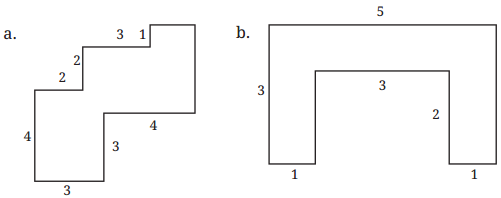
By splitting the following figures into rectangles, find their areas (all measures are given in meters):
Image

Answer

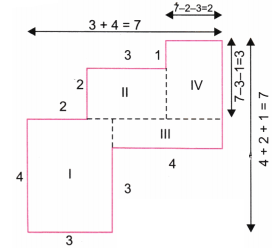
(a) Splitting the given figure into I, II, III, and IV rectangles as shown in the figure below, we get
Image
Here, the area of rectangle I = length × breadth
= 4 cm × 3 cm
= 12 sq. cm
Area of rectangle II = length × breadth
= 3 cm × 2 cm
= 6 sq. cm
Area of rectangle III = length × breadth
= 4 cm × 1 cm
= 4 sq. cm
Area of rectangle IV = length × breadth
= 3 cm × 2 cm
= 6 sq. cm
The total area of the whole figure = 12 sq. cm + 6 sq. cm + 4 sq. cm + 6 sq. cm = 28 sq. cm.
Therefore, the total area of Figure (a) is 28 sq. cm.
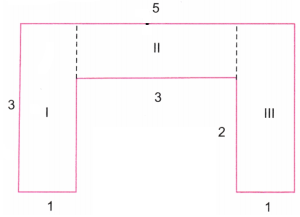
(b) Similarly, by splitting figure (b) into I, II, and III rectangles as shown in the figure below, we get
Image
Area of the rectangle I = length × breadth
= 3 cm × 1 cm
= 3 sq. cm
Area of rectangle II = length × breadth
= 3 cm × 1 cm
= 3 sq. cm
Area of rectangle III = length × breadth
= 3 cm × 1 cm
= 3 sq. cm
The total area of the figure = 3 sq. cm + 3 sq. cm + 3 sq. cm = 9 sq. cm.
Therefore, the total area of Figure (b) is 9 sq. cm.

Need a full question paper?

Generate a complete, print-ready paper with questions like this in minutes — across 16+ boards, with answer keys.

Start Generating Free

Similar questions

Match the equivalent fractions:
$(a) \frac{250}{400}$ $i.\frac{2}{3}$
$(b) \frac{180 }{200}$ $ii. \frac{2}{5}$
$(c) \frac{660}{990}$ $iii.\frac{1}{2}$
$(d) \frac{180}{360}$ $iv. \frac{5}{8}$
$(e) \frac{220}{550}$ $v. \frac{9}{10}$
Krishna received a $CD$ player for her birthday. She bought $3$ $CDs$ and received $5$ others as gifts. What fraction of her total $CDs$ did she buy and what fraction did she receive as gifts$?$
Solve the following equation and verify the answer: $16(3x - 5) - 10(4x - 8) = 40$
Draw a circle with centre $C$ and radius $3.4\ cm.$ Draw any chord $\overline{AB}$. Construct the perpendicular bisector of $\overline{AB}$ and examine, if it passes through $C.$
In Fig., name all rays with initial points as $A, B$ and $C$ respectively.
Image
(i) Is ray $\overrightarrow{A B}$ different from ray $\overrightarrow{A C}$ ?
(ii) Is ray $\overrightarrow{B A}$ different from ray $\overrightarrow{C A}$ ?
(iii) Is ray $\overrightarrow{C P}$ different from ray $\overrightarrow{C Q}$ ?
Write the fraction representing the shaded portion
See the adjacent figure and state the following statement are true and false.

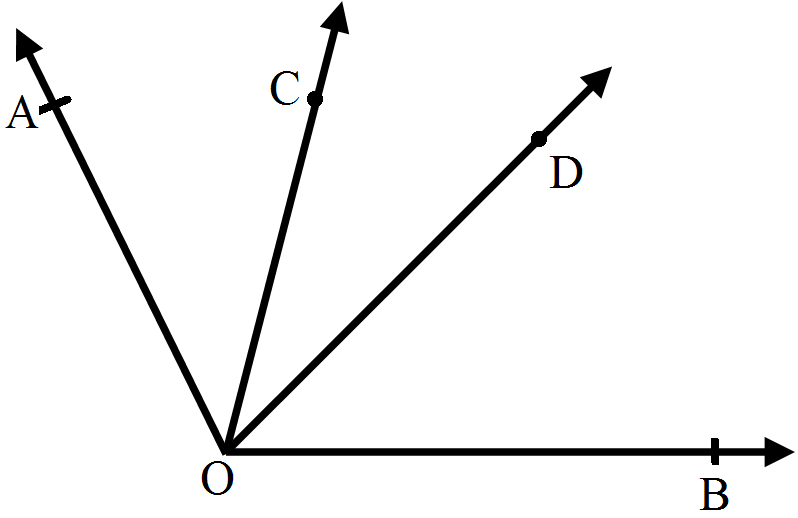
Point $C$ is in the interior of $\angle\text{AOC}.$
How many right angle do you make if you start facing west and turn to west?
Match the following:
$(a)$ Straight angle $(i)$ Less than one-fourth a revolution
$(b)$ Right angle $(ii)$ More than half a revolution
$(c)$ Acute angle $(iii)$ Half of a revolution
$(d)$ Obtuse angle $(iv)$ One-fourth a revolution
$(v)$Reflex angle $(v)$Between $\frac{1}{4}$ and $\frac{1}{2}$ of a revolution
  $(vi)$One complete revolution
What part of a revolution have you turned through if you stand facing east and turn clockwise to face north?