Calculate the amount of charge flowing in $2$ minutes in a wire of resistance $10$ $\Omega$ when a potential difference of $20\,V$ is applied between its ends ............ $C$
Easy
Download our app for free and get started
(b) $i = \frac{V}{R} = \frac{Q}{t} \Rightarrow Q = \frac{{Vt}}{R} = \frac{{20 \times 2 \times 60}}{{10}} = 240\,C$.

Download our appand get started for free
Experience the future of education. Simply download our apps or reach out to us for more information. Let's shape the future of learning together!No signup needed.*
Similar Questions
- 1The resistance of a wire of uniform diameter $d$ and length $L$ is $R$. The resistance of another wire of the same material but diameter $2d$ and length $4L$ will beView Solution
- 2View SolutionThe resistance of a discharge tube is
- 3Four resistances of $15\; \Omega, 12\; \Omega, 4 \;\Omega$ and $10\; \Omega$ respectively in cyclic order to form Wheats tone's network. The resistance that is to be connected in parallel with the resistance of $10\; \Omega$ to balance the network is .................. $\Omega$View Solution
- 4A rise of temperature of $4\,^oC$ is observed in a conductor by passing a current. If the current is tripled, the rise temperature will be .............. $^oC$View Solution
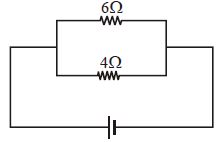
- 5In the circuit shown, the power developed in the $6\,\Omega $ resistor is $6\,W.$ The power developed in the $4\,\Omega $ resistor is .............. $W$View Solution
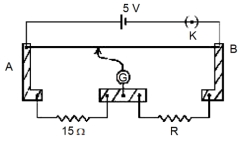
- 6A meter bridge setup is shown in the figure. It is used to determine an unknown resistance $R$ using a given resistor of $15\,\Omega$. The galvanometer $(G)$ shows null deflection when tapping key is at $43\,cm$ mark from end $A$. If the end correction for end $A$ is $2\,cm$. then the determined value of $R$ will be__________ $\Omega$View Solution
- 7The series combination of two batteries, both of the same emf $10 \mathrm{\;V},$ but different internal resistance of $20\; \Omega$ and $5\; \Omega,$ is connected to the parallel combination of two resistors $30\; \Omega$ and $\mathrm{R}\; \Omega .$ The voltage difference across the battery of internal resistance $20\; \Omega$ is zero, the value of $\mathrm{R}(\text { in } \Omega)$ isView Solution
- 8At room temperature $\left(27^{\circ} \mathrm{C}\right)$, the resistance of a heating element is $50 \Omega$. The temperature coefficient of the material is $2.4 \times 10^{-4}{ }^{\circ} \mathrm{C}^1$. The temperature of the element, when its resistance is $62 \Omega$, is $\qquad$ ${ }^{\circ} \mathrm{C}$.View Solution
- 9A potentiometer wire, $10\,m$ long, has a resistance of $40\,\Omega $. It is connected in series with a resistance box and a $2\,V$ storage cell. If the potential gradient along the wire is $0.1\,m\,V/cm$, the resistance unplugged in the box is .............. $\Omega$View Solution
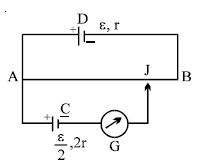
- 10In the figure, the potentiometer wire $AB$ of length $L$ and resistance $9r$ is joined to the cell $D$ of $\mathrm{emf}$ $\varepsilon$ and internal resistance $r$. The cell $C’s$ $\mathrm{emf}$ is $\varepsilon /2$ and its internal resistance is $2r$. The galvanometer $G$ will show no deflection when the length $AJ$ isView Solution