Question
Calculate the dimensions of force and impulse taking velocity, density and frequency as basic quantities.
Answer

$
v=LT^{-1}, \rho=ML^{-3}, v=T^{-1}
$
Solving for $M , L$ and T in terms of $v , \rho$ and $v$, we get
$
\begin{aligned}
& T=v^{-1}, L=v \nu^{-1} l, M=\rho v^3 \nu^{-3} \\
& \text { [Force] }=MLT^{-2}=\rho v^3 \nu^{-3} v \nu^{-1} v^2=\rho v^4 \nu^{-2} \\
& \text { [Impulse] = Force } \times \text { time }=\rho v^4 \nu^{-2} v^{-1}=\rho v^4 \nu^{-3}
\end{aligned}
$

Need a full question paper?

Generate a complete, print-ready paper with questions like this in minutes — across 16+ boards, with answer keys.

Start Generating Free

Similar questions

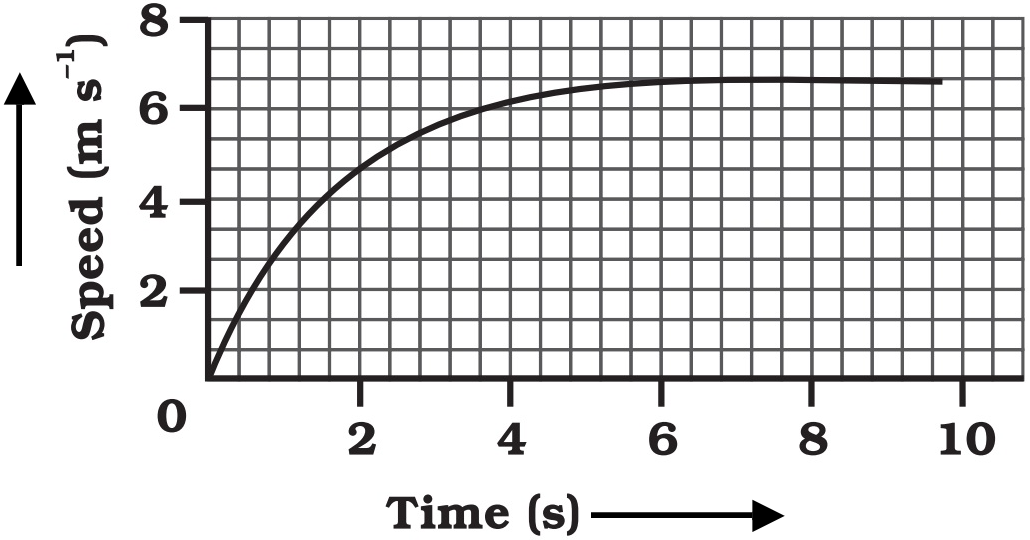
The speed-time graph for a car is shown in figure below.

  1. Find how far the car travels in the first 4s? Shade the area on the graph that represents the distance travelled by the car during the period.
  2. Which part of the graph represent uniform motion of the car?
A particle is moving in a straight line. Is it possible for it to maintain the motion in the same direction while the acceleration is in the reverse direction?
To what angle a cyclist has to bend to negotiate a curved path? Derive an expression.
Why should a bat be able to sense high frequencies?
Verify that the units weber and volt-second are the same.
From the given example, find if the motion is one or two or three-dimensional.
  1. A kite flying in the sky.
  2. A cricket ball hit by a player.
  3. Moon revolving around the earth.
  4. The motion of a stone in a circle.
Can a body have energy without having momentum and have momentum without having energy? Explain.
A person driving a car suddenly applies the brakes on seeing a child on the road ahead. If he is not wearing seat belt, he falls forward and hits his head against the steering wheel. Why?
Why is the weight of a body at the poles more than the weight at the equator? Explain.
A glass contains some water at room temperature 20°C. Refrigerated water is added to it slowly. When the temperature of the glass reaches 10°C, small droplets condense on the outer surface. Calculate the relative humidity in the room. The boiling point of water at a pressure of 17.5mm of mercury is 20°C and at 8.9mm of mercury it is 10°c.