Question
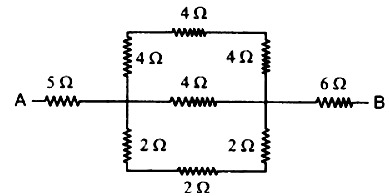
Calculate the equivalent resistance between the points $A$ and $B$ for the following combination of resistors:
Answer


$\frac{1}{ R _{1^{\prime}}}=\frac{1}{12}+\frac{1}{4}+\frac{1}{6}=\frac{1+3+2}{12}=\frac{6}{12}$
$\frac{1}{ R _1^{\prime}}=\frac{1}{2}$
$R_1' = 2 \Omega$
Total resistance $= 5 + 2 + 6 = 13$ ohm.

Need a full question paper?

Generate a complete, print-ready paper with questions like this in minutes — across 16+ boards, with answer keys.
Start Generating Free

Similar questions

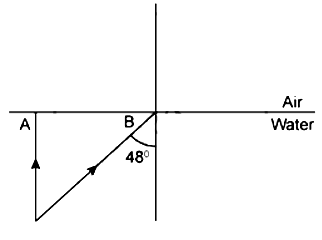
In following figure , show two rays A and B travelling from water to air. If the critical angle for water- air surface is 48°, complete the ray diagram showing the refracted rays for each. State conditions when the ray will suffer total internal reflection.
What is a fuse? Name the material of fuse. State on characteristic of material used for fuse.
(i) A molten metal weighing 150 g is kept at its melting point 800°C. When it is allowed to solidify at the same temp, it gives out 75000 J of heat. What is the specific heat of the metal?

(ii) If its specific heat capacity is 200 J/kgK? How much additional heat will it give out in cooling to -50°C?
An electric bulb is rated '100 W, 250 V'. How much current will the bulb draw if connected to a 250 V supply ?
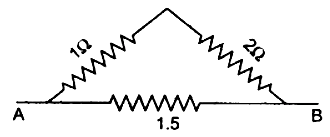
Calculate the effective resistance between the points A and B in the network shown below in Figure 8.45
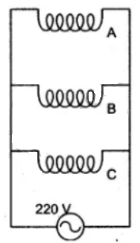
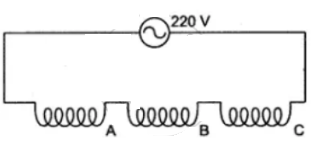
The diagram shows two ways of connecting three lamps P, Q and R to A.C. supply of 220 V.

Image

Image

Name the two arrangements. Which of them would you prefer in a household circuit? Give a reason for your answer.
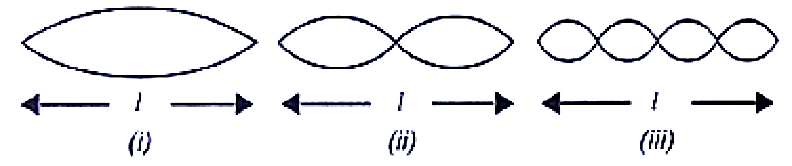
The following diagram shows three ways in which the string of an instrument can vibrate.


(a) which of the diagram shows the principal note?
(b) which has the frequency four times that of the first?
(c) what is the ratio of the frequency of the vibration in (i) and (ii)?
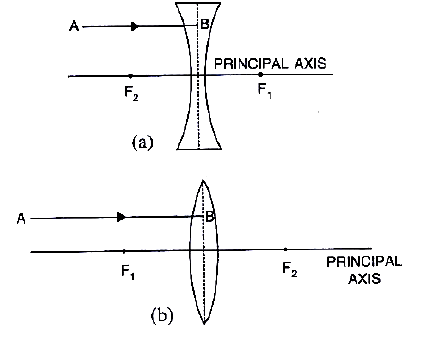
In following figure ,, F1 and F2 are the positions of the two foci of the thin lenses shown in diagram (a) and (b) draw accurately the path taken by the light ray AB after it emerges from the lens in each diagram (a) and (b).

State one factor on which a critical angle for a given pair of media depends. The critical angle for the glass-air interface is $45^{\circ}$ for the yellow light. Will it be equal to, less than or greater than $45^{\circ}$ for (i) red light, (ii) blue light?
The refractive index of air with respect to glass is defined: as ${ }_g \mu_a=\sin i / \sin r$
Write down a similar expression for $a _{ g }$ in terms of angle i and r .