Questions

[3 Mark Question Answer]

🎯

Test yourself on this topic

35 questions · timed · auto-graded

Question 13 Marks
Calculate the value of the resistance which must be connected to a 15 ohm resistance to provide on effective resistance of 6 ohm.
Answer
Resistance decreases in parallel combination. S let R resistance is connected to 15 Ω resistance parallel to make resultant 6 ohm.
Now, $\frac{1}{6}=\frac{1}{15}+\frac{1}{ R }$
or $\frac{1}{ R }=\frac{1}{6}-\frac{1}{15}$
$=\frac{5-2}{30}=\frac{3}{30}=\frac{1}{10}$
∴ R = 10 Ω
View full question & answer
Question 23 Marks
What should be the length of a nickel wire of area of cross-section $3 mm^2$ used for making a rheostat of 750 ohm? ( $\rho$ of nickle $=$ $\left.0.069 Ohm mm ^2 / m \right)$
Answer
Specific resistance $=\rho=0.069 ohm \frac{ mm ^2}{ m }$
$R = 750 W$
$A = 3mm^{2 }$ as $I =\frac{ R \times A }{\rho}=\frac{750 \times 3}{0.069}$
$\therefore$ length $l = 32608.7$ metre
The length of a nickel wire should be $32608.7 m.$
View full question & answer
Question 33 Marks
A cell of e.m.f $2.0 V$ and internal resistance $1 \Omega$ is connected to the resistors of $3 \Omega$ and $6 \Omega$ in series. Calculate:
(i) the current drawn from the cell,
(ii) the p.d. across each resistor,
(iii) the terminal voltage of the cell and
(iv) the voltage drop.
Answer
Total resistance of the circuit $R=1+3+6=10 \Omega$
(i) The current drawn from the cell =
$\frac{E}{R}=\frac{2.0}{10}=0.2 A$
(ii) The p.d. across $3 \Omega$ resistor $V _1= R _1=0.2 \times 3=0.6 V$
The p.d. across $6 \Omega$ resistor $V _2= R _2=0.2 \times 6=1.2 V$
(iii) The terminal voltage of the cell $V = V_1 + V_2$
$= 0.6 + 1.2 = 1.8 V$
(iv) The voltage drop $= E - V = 2.0 - 1.8 = 0.2 V$
View full question & answer
Question 43 Marks
An electrical appliance is rated at $1000 KVA, 220V$. If the appliance is operated for $2$ hours, calculate the energy consumed by the appliance in: $(i)$ kWh $(ii)$ joule.
Answer
Given: $V = 220$ volt, $1000 KVA$
Time $= 2$ hours
(i) In kWh Energy consumed $= Pt = 2000 kWh$
(ii) In joule
We know, $1kWh = 3.6 \times 10^6 J$
So, $2000 kWh =\frac{2000 \times 3.6 \times 10^6}{1}$
$= 7.2 \times 10^9$ Joule
$= 7.2 \times 10^9 J$
View full question & answer
Question 53 Marks
The resistance of two resistors joined in series is $8 \Omega$ and in parallel is $1.5 \Omega$. Find the value of the two resistances.
Answer
In series, $R _1+ R _2=8 \Omega$
In parallel $\frac{R_1 R_2}{R_1+R_2}=1.5 \Omega$
$\therefore R_1 R_2=8 \times 1.5=12 \Omega$
Now $\left(R_1-R_2\right)^2=\left(R_1+R_2\right)^2-4 R_1 R_2$
$\therefore\left(R_1-R_2\right)^2=(8)^2-4 \times 12$
$\operatorname{or}\left(R_1-R_2\right)^2=64-48=16$
or $R_1-R_2=4 \Omega$
On solving equations (i) and (ii) $R_1=6 \Omega$ and $R_2=2 \Omega$
View full question & answer
Question 63 Marks
Two resistors having $2Ω$ and $3Ω$ resistance are connected—(i) in series, and (ii) in parallel. Find the equivalent resistance in each case.
Answer
Given: $R_1 = 2 \Omega , R_2 = 3 \Omega$
(i) In series : Equivalent resistance $R = R_1 + R_2$​​​​​​​
or $R = 2 + 3 = 5 \Omega$
(ii) In parallel : Equivalent resistance $R=\frac{R_1 R_2}{R_1+R_2}$
or $R =\frac{2 \times 3}{2+3}=\frac{6}{5}=1.2 \Omega$
View full question & answer
Question 73 Marks
Two wires of same material and same lengths have radii in the ratio of $2 : 3$, Compare their resistances.
Answer
Given: $r_1 : r_2 = 2 : 3$
Area of cross-section of wire $= a = \pi r^2$​​​​​​​
$\therefore a _1: a _2= r _1^2: r _2^2=4: 9$
Resistance of wire $R \propto \frac{1}{ a }$
$\therefore \frac{ R _1}{ R _2}=\frac{ a _2}{ a _1}=\frac{9}{4}$
View full question & answer
Question 83 Marks
Calculate the quantity of heat that will be produced in a coil of resistance $75 \Omega$ if a current of 2 A is passed through it for $2$ minutes.
Answer
$R = 75 \Omega , i = 2A, t = 2$ minutes $= 2 \times 60 s = 120$ sHeat energy produced in the coil, $H = i^2Rt$
$= 2^2 \times 75 \times 120$
$= 300 \times 120 = 36000 J$
View full question & answer
Question 93 Marks
State the factors on which the e.m.f of a cell depends.
Answer
The e.m.f. of different cell depends on the following factors:
(i) The material of the electrodes.
(ii) The electrolyte used in the cell.
It is to be noted that the e.m.f. of a cell does not depend on its shape or size.
View full question & answer
Question 103 Marks
State a relation between electrical power, resistance and potential difference in an electrical circuit.
Answer
In an electrical circuit, electrical power
$P = V^2/R$
where $V =$ potential difference and $R =$ resistance.
View full question & answer
Question 113 Marks
State the conditions for the flow of charge in a circuit from one point to the other.
Answer
The main condition for the flow of charge between two points is the difference in their potentials. If the potential difference is greater, a strong current flows and if both points are at the same potential, no current will flow.
View full question & answer
Question 123 Marks
Name two factors on which the internal resistance of a cell depends and state how does it depend on the factors stated by you.
Answer
Internal resistance of a cell depends upon the following factors:

(i) The surface area of the electrodes: Larger the surface area of the electrodes, less is the internal
resistance.
(ii) The distance between the electrodes: As the distance between the electrodes increases, the internal resistance of cell also increases. It is also affected by the nature, concentration and temperature of the solution (electrolyte).

View full question & answer
Question 133 Marks
Write an expression for the resistance of a conducting wire in terms of its length and area of cross-section.
Answer
Let R be the resistance of a conducting wire of length l and area of cross-section A. We then have:
R = ρl/A
Here ρ is a constant characteristic of the material of the wire and is called its resistivity. Thus,
Resistance =
\begin{tabular}{c|c}
(Resistivity of the material of the wire $) \times($ length of thge $w$ \\
\hline Area of cross-section of the wire &
\end{tabular}
View full question & answer
Question 143 Marks
Define ampere and volt with respect to Ohm’s law.
Answer
Ampere: It is the S.I. unit of current. If a current flows in a conductor of resistance of 1Ω, when the potential difference across its ends is 1 volt, the current is said to be 1 ampere, i.e.,
1 ampere = 1 volt/1 ohm
Volt: It is the S. I. unit of potential difference. If a current of 1 ampere flows in a conductor of resistance 1 ohm, then potential difference across its ends is said to be 1 volt, i.e.,
1 volt = 1 ampere × 1 ohm.
View full question & answer
Question 153 Marks
Define the term current and state its S.I unit.
Answer
Current is defined as the rate of flow of charge.
i.e. $I=\frac{Q}{t}$
Its S.I. unit is Ampere (A), where $1 A =\frac{1 \text { coulomb }}{1 \text { second }}$.
View full question & answer
Question 163 Marks
Explain why potential difference is always less than the e.m.f. of a cell?
Answer
When a cell is in closed circuit, i.e., when current is drawn from it, then the potential difference between its electrodes is called the terminal voltage. It is always less than the e.m.f. because when charge flows in a circuit, some energy is spent in the flow of charge through the electrolyte of the cell.
View full question & answer
Question 173 Marks
A cell of e.m.f. E and internal resistance r is used to send current I in an external resistance R. Write expressions for (i) the current drawn from the cell,
(ii) the terminal voltage V of the cell, and
(iii) the voltage drop across the internal resistance. How are E and V related?
Answer
Total resistance of circuit = R + r
(i) The current drawn from the cell, $I+\frac{E}{R+r}$
(ii) The terminal voltage of the cell, V = IR
(iii) The voltage drop across the internal resistance = IR
E and V are related as E = V + IR.Total resistance of circuit = R + r
(i) The current drawn from the cell, $I+\frac{E}{R+r}$
(ii) The terminal voltage of the cell, V = IR
(iii) The voltage drop across the internal resistance = IR
E and V are related as E = V + IR.
View full question & answer
Question 183 Marks
A 10 m long wire of a particular material is of resistance 5Ω What will be the resistance if the wire is doubled itself.
Answer
Given: The resistance of 10 m long wire = 5 Ω
On doubling the wire on itself the length is reduced to half and the area of cross-section is doubled so the resistance is reduced to one-fourth i.e. the resistance of the wire will become:
$\frac{1}{4} \times 5 \Omega=1.25 \Omega$
View full question & answer
Question 193 Marks
A $10 \ m$ long wire of a particular material is of resistance $5Ω$ What will be the resistance of $10\ m$ long wire of the same material but the double radius.
Answer
Given: The resistance of 10 m long wire $= 5 \Omega$
For the wire of double the radius, the area of cross-section $(a = \pi r^2)$ of wire will be four times that of
previous wire. Since resistance $R \alpha \frac{1}{ a }$. So the
resistance of new wire will be one-fourth of the
previous wire i.e., it will be $\frac{1}{4} \times 5 \Omega=1.25 \Omega$
View full question & answer
Question 203 Marks
A 10 m long wire of a particular material is of reistance 5Ω What will be the resistance of 5m long wire of same material and the same thickness.
Answer
Given: The resistance of 10 m long wire = 5 Ω
R α l for the same thickness material so if the length of wire becomes half of the previous value, resistance will also become 1/2th of its previous value.
Or $R =\frac{1}{2} \times 5 \Omega=2.5 \Omega$
View full question & answer
Question 213 Marks
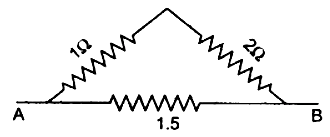
Calculate the effective resistance between the points A and B in the network shown below in Figure 8.45
Answer
In the diagram, 2Ω and 1Ω resistances are in series. The equivalent resistance of the arm R' = 2 + 1 = 3 Ω
Between the points A and B, the equivalent resistance R' (= 3 Ω) is in parallel with 1.5 Ω
Hence, total effective resistance between A and B is
$R =\frac{3 \times 1.5}{3+1.5}=\frac{4.5}{4.5}=1.0 \Omega$
View full question & answer
Question 223 Marks
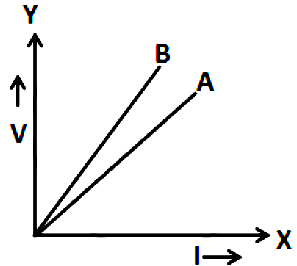
The V-I graph for a series combination and for a parallel combination of two resistors is shown in the figure below. Which of the two A or B. represents the parallel combination? Give reasons for your answer.
Answer
For the same change in I, change in V is less for the straight line A than for the straight line B (i.e. the straight line A is less steep than B). The straight line A represents small resistance, while the straight line B represents more resistance. The equivalent resistance is less in a parallel combination than in a series combination. So, line A represents a parallel combination.
View full question & answer
Question 233 Marks
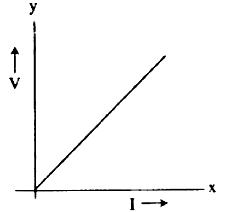
Draw a graph of Potential difference (V) versus Current (I) for an ohmic resistor. How can you find the resistance of the resistor from this graph?
Answer
We can find resistance by finding the slope of the graph.

Graph of V versus I for an Ohmic conductor
We can find resistance by finding the slope of the graph.
View full question & answer
Question 243 Marks
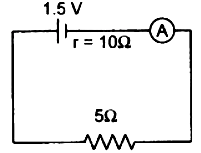
A cell of emf. 1.5 V and internal resistance 10 ohms is connected to a resistor of 5 ohms, with an ammeter in series see fig.. What is the reading of the ammeter?
Answer

E = i (R + r)
1.5 = i(5 + 10)
$\Rightarrow \frac{1.5}{15}$
i = 0.1 Å.
View full question & answer
Question 253 Marks
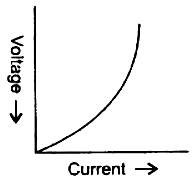
What are non-ohmic conductors? Give one exmaple. Draw a current-voltage graph for a non-ohmic conductor.
Answer
The conductors which do not obey Ohm’s law (i.e., V/I is not constant) are called non-ohmic conductors.
Example: Diode valve.

The current-voltage graph for a non-ohmic conductor is shown in figure alongside.
View full question & answer
Question 263 Marks
Three resistors of 6Ω, 3Ω and 2Ω are connected together so that their total resistance is greater than 6Ω but less than 8Ω Draw a diagram to show this arrangement and calculate its total resistance.
Answer
We connect the resistance of 3 Ω and 2 Ω in parallel to each other and then connect this (parallel combination) to the 6 Ω resistance in series. The required arrangement is as shown in given figure. The equivalent resistance of 3Ω and 2 Ω in parallel.
$\frac{1}{ R }=\frac{1}{3}+\frac{1}{2}=\frac{2+3}{6}=\frac{5}{6}$
or $R=\frac{6}{5} \Omega=1.2 \Omega$
Thus, the total resistance of the set up is (1.2 + 6) Ω = 7.2 Ω
View full question & answer
Question 273 Marks
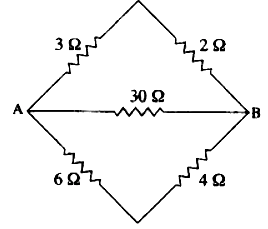
Calculate the equivalent resistance between A and B in the adjacent diagram.Calculate the equivalent resistance between A and B in the adjacent diagram.
Answer
$R_1 = 3 + 2 = 5$ ohm
$R_2 = 30 W$
$R_3 = 6 + 4 = 10$ ohm
$R _1, R _2$ and $R _3$ are connected in parallel
$\frac{1}{ R }=\frac{1}{ R _1}+\frac{1}{ R _2}+\frac{1}{ R _3}$
$=\frac{1}{5}+\frac{1}{30}+\frac{1}{10}=\frac{10}{30}$
$R = 3 ohm$
View full question & answer
Question 283 Marks
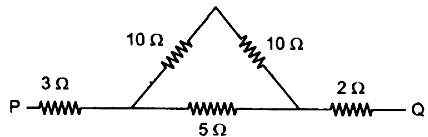
Calculate the equivalent resistance between $P$ and $Q$ from the following diagram:
Answer

$\frac{1}{ R _1}=\frac{1}{20}+\frac{1}{5}$
$\frac{1}{ R _1}=\frac{1+4}{20}=\frac{5}{20}$
$R_1 = 4 \Omega$
Now, $3 \Omega , 4 \Omega$ and $2 \Omega $ in series.
So, $R = 3 + 4 + 2 = 9 \Omega$
View full question & answer
Question 293 Marks
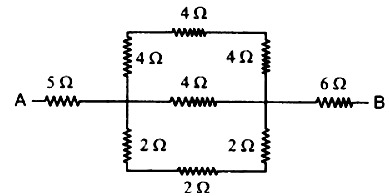
Calculate the equivalent resistance between the points $A$ and $B$ for the following combination of resistors:
Answer

$\frac{1}{ R _{1^{\prime}}}=\frac{1}{12}+\frac{1}{4}+\frac{1}{6}=\frac{1+3+2}{12}=\frac{6}{12}$
$\frac{1}{ R _1^{\prime}}=\frac{1}{2}$
$R_1' = 2 \Omega$
Total resistance $= 5 + 2 + 6 = 13$ ohm.
View full question & answer
Question 303 Marks
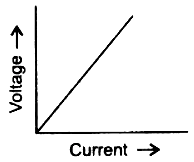
What are ohmic conductors? Give one exmaple. Draw a graph showing the current-voltage relationship for an ohmic conductor.
Answer
The conductors which obey Ohm’s law (i.e., V/I is constant) are called ohmic conductors.
Example: Silver.

A graph showing the current-voltage relationship for a ohmic conductor is shown in the figure.
View full question & answer
Question 313 Marks
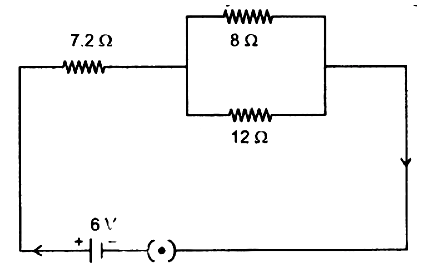
Three resistors are connected to a $6 V$ battery as shown in the figure given below:

Calculate:
(i) the equivalent resistance of the circuit.
(ii) total current in the circuit.
(iii) potential difference across the $7.2 Ω$ resistor.
Answer
(i) $\frac{1}{ R _1}=\frac{1}{8}+\frac{1}{12}$
$=\frac{3+2}{24}=\frac{5}{24}$
$R_1 = 4.8$ ohm.
Total Resistance $= 4.8 + 7.2 = 12$ ohm
$(ii) V = IR$
$6 = I \times 12$
$I = 0.5$ Amp.
$(iii) V = IR$
$= 0.5 \times 7.2$
$= 3.6 Volt.$
View full question & answer
Question 323 Marks
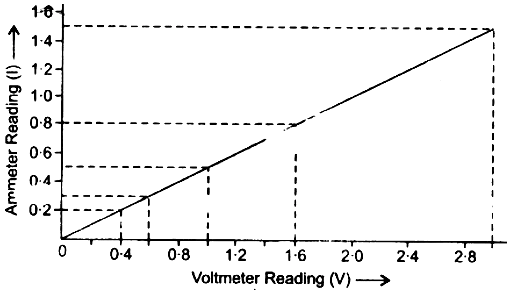
From the following observations taken while determining the resistance of a conductor, draw the current-voltage graph and calculate the resistance of conductor. Is the conductor ohmic?
Ammeter reading I (in ampere) Voltmeter reading V (in volt)
0.2 0.4
0.3 0.6
0.5 1.0
0.8 1.6
1.5 3.0
Answer
The current-voltage graph is shown in figure.

Resistance $R =\frac{\Delta V }{\Delta I }$
$=\frac{(3.0-0.6) V }{(1.5-0.3) A }$
$=\frac{2.4 V }{1.2 A }=2 \Omega$
The conductor is ohmic.
View full question & answer
Question 333 Marks
In the figure given below, $A, B$ and $C$ are three ammeters. The ammeter $B$ reads $0.5 A$ . (All the ammeters have negligible resistance.)
Calculate:
(i) the readings in the ammeters $A$ and $C .$
(ii) the total resistance of the circuit.
Answer
(i) P.d. across $6 \Omega=$ P. d. across $3 \Omega$
Or $6 \times 0.5=3 \times i_c$
Or $i _{ C }$ i.e., current passing through the ammeter $C$ is:
$\frac{6 \times 0.5}{3}=1.0$ ampere
(ii) Here, $\frac{1}{ R }=\frac{1}{6}+\frac{1}{3}=\frac{3}{6}=\frac{1}{2}$
or $R = 2 \Omega$
$\therefore$ Total ressistance of the circuit $=2 \Omega+R=2 \Omega+2 \Omega=4 \Omega$
$\therefore$ Current through $A =$ Current passing through $B +$ current passing through C $=0.5+1.0=1.5$ ampere
View full question & answer
Question 343 Marks
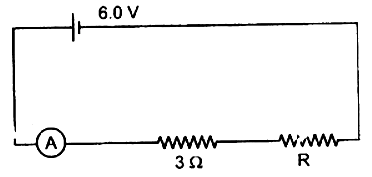
The figure shows a circuit. When the circuit is switched on, the ammeter reads $0.5 A.$

(i) Calculate the value of the unknown resistor $R.$
(ii) Calculate the charge passing through the $3 Ω$ resistor in $120 s.$
(iii) Calculate the power dissipated in the $3 Ω$ resistor.
Answer
(i) We know, $V = IR'$
$\Rightarrow 6 = 0.5 \times R'$
$\Rightarrow R' = 12 Ohm$
$\because R' = 3 + R$
$\Rightarrow 12 = 3 + R$
$\Rightarrow R = 9$ Ohm
(ii) Charge, $q = i t$
$\Rightarrow q = 0.5 \times 120 = 60$ Coulomb
(iii) Power dissipation, $p = i^2R$
$p = 0.5^2 \times 3 = 0.75$ Watt
View full question & answer
Question 353 Marks
Two resistors of 4Ω and 6Ω are connected in parallel to a cell to draw 0.5 A current from the cell. Calculate the current in each resistor.
Answer
$\frac{1}{ R }=\frac{1}{4}+\frac{1}{6}$
R = 2.4 Ω
⇒ V = IR
V = 0.5 × 2.4 = 1.2 V
$i_1=\frac{V}{R_1}$
$=\frac{1.2}{4}=0.3 A$
$i _2=\frac{1.2}{6}=0.2 A$
View full question & answer
[3 Mark Question Answer] - Physics STD 10 Questions - Vidyadip