Question
  1. Calculate the equivalent resistance of the given electrical network between points A and B.
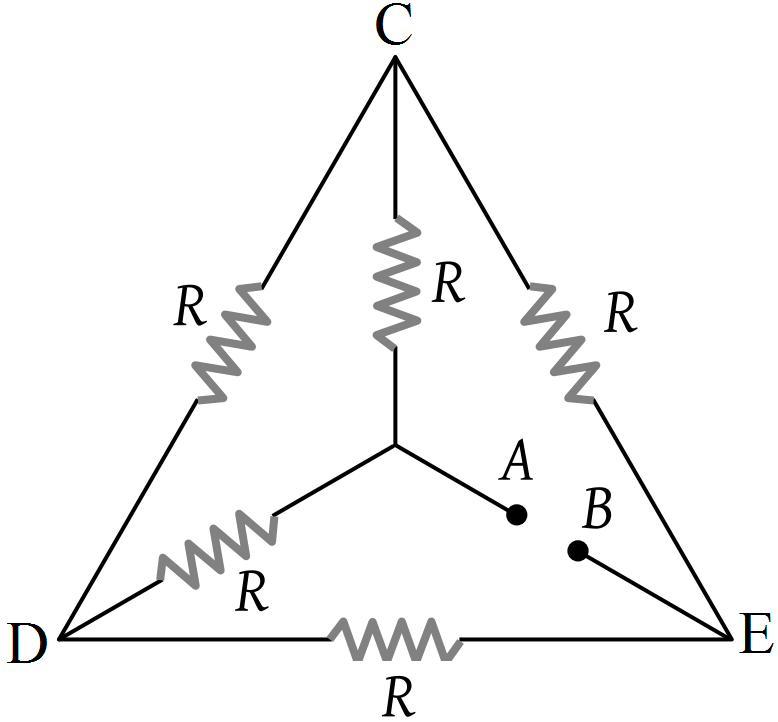
  1. Also calculate the current through CD and ACB if a 10V dc source is connected between points A and B and the value of $\text{R}=2\Omega.$
Answer


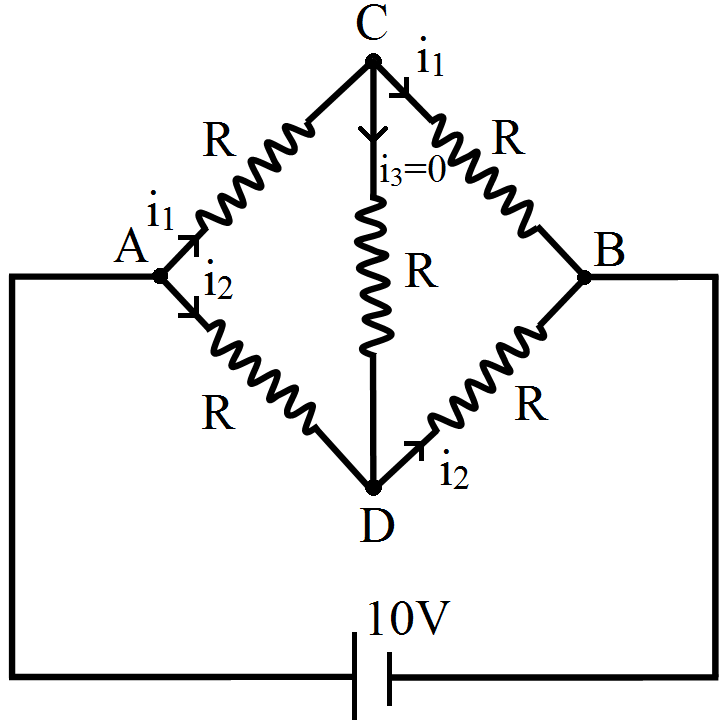
  1. The equivalent circuit is shown in fig. It is a balanced Wheatstone bridge.

So, the resistance connected between C and D is ineffective.

Resistance of arm ACB, R1 = R + R = 2R

Resistance of arm ADB, R2 = R + R = 2R

Equivalent resistance between A and B, RAB is given by

$\frac{1}{\text{R}_\text{AB}}=\frac{1}{2\text{R}}+\frac{1}{2\text{R}}=\frac{2}{2\text{R}}$

$\Rightarrow\text{R}_\text{AB}=\text{R}=2\Omega$

  1. In arm CD, there is no current, ICD = 0,

Current through arm ACB

$\text{i}_1=\frac{\text{V}}{\text{R}_1}$

$=\frac{10}{2\text{R}}=\frac{10}{2\times2}=\frac{10}{4}=2.5\text{A}$

Need a full question paper?

Generate a complete, print-ready paper with questions like this in minutes — across 16+ boards, with answer keys.

Start Generating Free

Similar questions

An electrical technician requires a capacitance of 2μF in a circuitacross a potential difference of 1kV. A large number of 1μF capacitors are available to him each of which can withstand a potential difference of not more than 400V. Suggest a possible arrangement that requires the minimum number of capacitors.
A tightly-wound solenoid of radius a and length l has n turns per unit length. It carries an electric current i. Consider a length dx of the solenoid at a distance x from one end. This contains n(dx) turns and may be approximated as a circular current in (dx).
  1. Write the magnetic field at the centre of the solenoid due to this circular current. Integrate this expression under proper limits to find the magnetic field at the centre of the solenoid.
  2. Verify that if a >> l, the field tends to $\text{B}=\frac{\mu_0\text{nil}}{2\text{a}}.$ Interpret these results.
A small block of mass m and a concave mirror of radius R fitted with a stand lie on a smooth horizontal table with a separation d between them. The mirror together with its stand has a mass m. The block is pushed at t = 0 towards the mirror so that it starts moving towards the mirror at a constant speed V and collides with it. The collision is perfectly elastic. Find the velocity of the image:
  1. At a time $\text{t}<\frac{\text{d}}{\text{V}}$
  2. At a time $\text{t}>\frac{\text{d}}{\text{V}}.$
A rectangular conducting loop consists of two wires on two opposite sides of length l joined together by rods of length d. The wires are each of the same material but with cross-sections differing by a factor of 2. The thicker wire has a resistance R and the rods are of low resistance, which in turn are connected to a constant voltage source V0. The loop is placed in uniform a magnetic field B at 45° to its plane. Find $\tau$, the torque exerted by the magnetic field on the loop about an axis through the centres of rods.
Two wires carrying equal currents i each, are placed perpendicular to each other, just avoiding a contact. If one wire is held fixed and the other is free to move under magnetic forces, what kind of motion will result?
  1. Plot a graph showing variation of voltage vs the current drawn from the cell. How can one get information from this plot about the emf of the cell and its internal resistance?
  2. Two cells of emf’s E1 and E2 and internal resistance r1 and r2 are connected in parallel. Obtain the expression for the emf and internal resistance of a single equivalent cell that can replace this combination?
Three particles of masses 1.0kg, 2.0kg and 3.0kg are placed at the corners A, B and C respectively of an equilateral triangle ABC of edge 1m. Locate the centre of mass of the system.
A 10g bullet with a charge of $4.00\mu\text{C}$ is fired at a speed of 270m/s-1 in a horizontal direction. A vertical magnetic field of $500\mu\text{T}$ exists in the space. Find the deflection of the bullet due to the magnetic field as it travels through 100m. Make appropriate approximations.
Two identical metal balls one at $\text{T}_1=300\text{K}$ and the other at $\text{T}_2=600\text{K}$ are kept at a distance of 1m in vacuum. Will the temperatures equalise by radiation? Will the rate of heat gained by the colder sphere be proportional to $\text{T}_2^4-\text{T}_1^4$ as may be expected from the Stefan's law?
When a circuit element ‘X’ is connected across an a.c. source, a current of $\sqrt{2}\text{A}$ flows through it and this current is in phase with the applied voltage. When another element ‘Y’ is connected across the same a.c. source, the same current flows in the circuit but it leads the voltage by $\frac{\pi}{2}$ radians.
  1. Name the circuit element X and Y.
  2. Find the current that flows in the circuit when the series combination of X and Y is connected across the same a.c. voltage.
  3. Net impedance.