Question
Calculate the force with which you attract the earth.

Answer

Consider that a man is standing on the surface of the Earth.

Force acting on the man = mg

Here, m = mass of the man and g = acceleration due to gravity on the surface of earth (= 10m/s2)

Assume that the mass of the man is equal to 65kg.

Then F = W = mg = 65 × 10 = 650N = force acting on the man

$\therefore$ By Newton's third law (action-reaction are always equal), the man is also attracting the earth with a force of 650N in the opposite direction.

Need a full question paper?

Generate a complete, print-ready paper with questions like this in minutes — across 16+ boards, with answer keys.

Start Generating Free

Similar questions

A police jeep is chasing a culprit going on a motorbike. The motorbike crosses a turning at a speed of 72km/h. The jeep follows it at a speed of 90km/h, crossing the turning ten seconds later than the bike. Assuming that they travel at constant speeds, how far from the turning will the jeep catch up with the bike?
An electron revolves around an infinite positive linear charge in a circular orbit of radius 0.5 m . If the line charge density is $18.2 \times 10^{-10}$ Coulomb/ meter, then find the speed of the electron (in $m / s$ ). (Mass of electron $m=9.1 \times 10^{-31} kg$ )
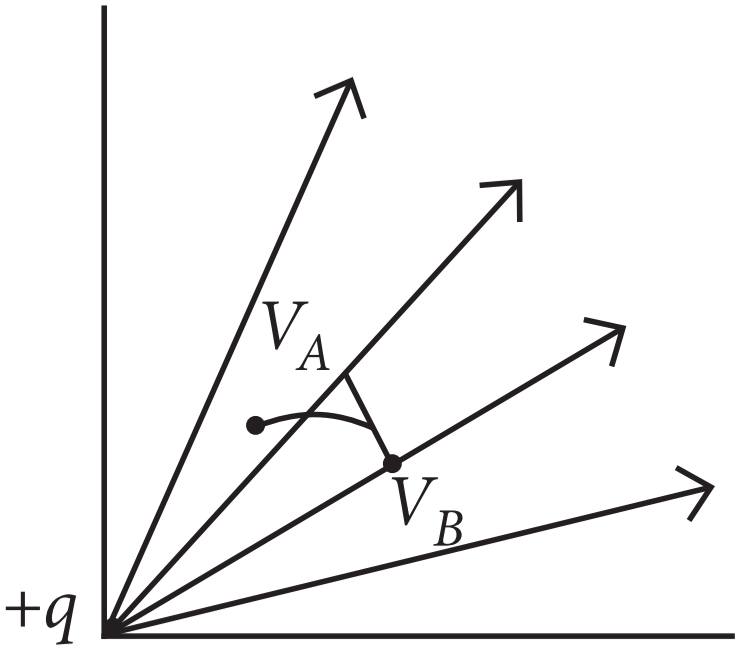
Electrostatic potential energy of a system of point charges is defined as the total amount of work done in bringing the different charges to their respective positions from infinitely charge mutual separations. The work is stored in the system of two point charges in the form of electrostatic potential energy U of the system. Electric potential difference between any points A and B in an electric field is the amount of work done in moving a unit positive test charge from A to B along any path agents the electrostatic force $\text{V}_\text{B}-\text{V}_\text{A}=\frac{\text{W}_\text{AB}}{\text{q}_\text{o}}=\int\vec{\text{E}}.\text{dl}.$

  1. A test charge is moved from lower potential point to a higher potential point. The potential energy of test charge wiII.
  1. Remain the same.
  2. Increase.
  3. Decrease.
  4. Become zero.
  1. Which of the following statement is not true?
  1. Electrostatic force is a conservative force.
  2. Potential energy of charge q at a point is the work done per unit charge in bringing a charge from any point to infinity.
  3. Spring force and gravitational force are conservative force.
  4. Both (a) and (c).
  1. Work done in moving a charge from one point to another inside a uniformly charged conducting sphere is:
  1. Always zero.
  2. Non-zero.
  3. May be zero.
  4. None of these.
  1. The work done in bringing a unit positive charge from infinite distance to a point at distance x from a positive charge Q is W. Then the potential $\phi$ at that point is:
  1. $\frac{\text{WQ}}{\text{x}}$

  2. W

  3. $\frac{\text{W}}{\text{x}}$

  4. WQ

  1. If $1\mu\text{C}$ charge is shifted from A to B and it is found that work done by an external force is $40\mu\text{J}.$ ln doing so against electrostatics force, the potential difference VA - VB is:
  1. 40V
  2. -40V
  3. 20V
  4. -60V
Resistance of tungsten filament in one bulb at $27{ }^{\circ} C$ is $18 \Omega$. When this bulb is connected to 60 V source, steady current passing through it is 0.3 A . Find temperature of this filament taking $\alpha=4.5 \times 10^{-3} K^{-1}$. Assume that Ohm's law is obeyed.
A sample contains a mixture of 108Ag and 110Ag isotopes each having an activity of 8.0 × 10⁸ disintegration per second. 110Ag is known to have larger half-life than 108Ag. The activity A is measured as a function of time and the following data are obtained.
Time (s) Activity (A) (108 disinte- grations s-1)
Time (s) Activity (A) (108 disinte-grations s-1)
20 11.799 200 3.0828
40 9.1680 300 1.8899
60 7.4492 400 1.1671
80 6.2684 500 0.7212
100 5.4115    
  1. Plot ln $\Big(\frac{\text{A}}{\text{A}_0}\Big)$ versus time.
  2. See that for large values of time, the plot is nearly linear. Deduce the half-life of 110Ag from this portion of the plot.
  3. Use the half-life of 110Ag to calculate the activity corresponding to 108Ag in the first 50s.
  4. Plot In $\Big(\frac{\text{A}}{\text{A}_0}\Big)$ versus time for 108Ag for the first 50s.
  5. Find the half-life of 108Ag.
A short magnet makes 40 oscillations per minute when used in an oscillation magnetometer at a place where the earth's horizontal magnetic field is $2\mu\text{T.}$ Another short magnet of magnetic moment 1.6A-m2 is placed 20cm east of the oscillating magnet. Find the new frequency of oscillation if the magnet has its north pole:
  1. Towards north.
  2. Towards south.
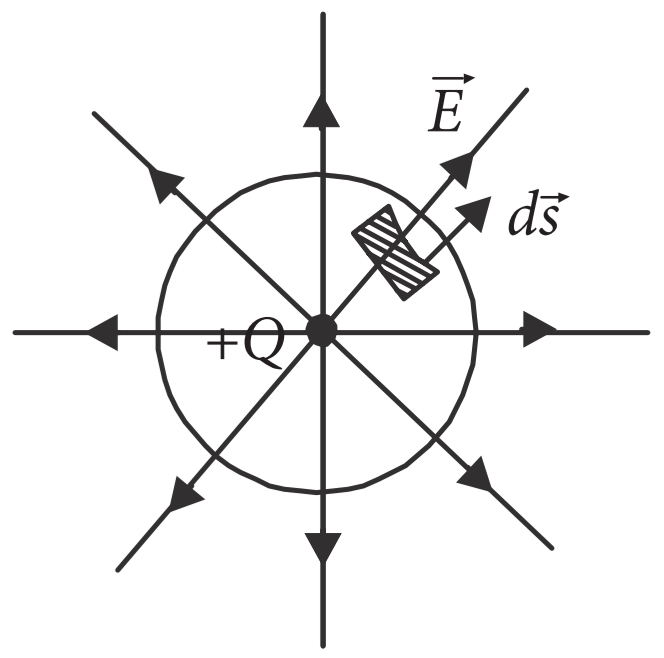
Gauss's law and Coulomb's law, although expressed in different forms, are equivalent ways of describing the relation between charge and electric field in static conditions. Gauss's law is $\in_0\phi=\text{q}_{\text{end},}$ when $\text{q}_{\text{encl}}$ is the net charge inside an imaginary closed surface called Gaussian surface. $\phi=\oint\vec{\text{E}}\cdot\text{d}\vec{\text{A}}$ gives the electric flux through the Gaussian surface. The two equations hold only when the net charge is in vacuum or air.

  1. If there is only one type of charge in the universe, then ($\vec{\text{E}}\rightarrow$ Electric field, $\text{d}\vec{\text{s}}\rightarrow$ Area vector).
  1. $\oint\vec{\text{E}}\cdot\text{d}\vec{\text{s}}\not=0$ on any surface.

  2. $\oint\vec{\text{E}}\cdot\text{d}\vec{\text{s}}$ could not be defined.

  3. $\oint\vec{\text{E}}\cdot\text{d}\vec{\text{s}}=\infty$ if charge is inside.

  4. $\oint\vec{\text{E}}\cdot\text{d}\vec{\text{s}}=0$ if charge is outside, $\oint\vec{\text{E}}\cdot\text{d}\vec{\text{s}}=\frac{\text{q}}{\in_0}$ if charge is inside.

  1. What is the nature of Gaussian surface involved in Gauss law of electrostatic?
  1. Magnetic.
  2. Scalar.
  3. Vector.
  4. Electrical.
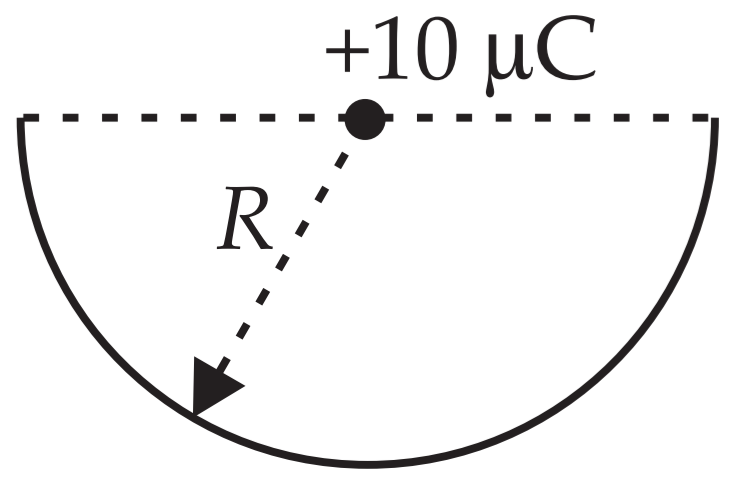
  1. A charge $10\mu\text{C}$ is placed at the centre of a hemisphere of radius R = 10cm as shown. The electric flux through the hemisphere (in MKS units) is:

  1. 20 × 105
  2. 10 × 105
  3. 6 × 10⁵
  4. 2 × 10⁵
  1. The electric flux through a closed surface area S enclosing charge Q is $\phi$. If the surface area is doubled, then the flux is:
  1. $2\phi$

  2. $\frac{\phi}{2}$

  3. $\frac{\phi}{4}$

  4. $\phi$

  1. A Gaussian surface encloses a dipole. The electric flux through this surface is:
  1. $\frac{\text{q}}{\in_0}$

  2. $\frac{\text{2q}}{\in_0}$

  3. $\frac{\text{q}}{2\in_0}$

  4. $\text{Zero}$

According to Einstein, when a photonoflight offrequencyu or wavelength $\lambda$ is incident on a photosensitive metal surface of work function $\phi_0$, where $\phi_0<\text{h}\upsilon$ (here, h is Planck's constant), then the emission of photoelectrons takes place. The maximum kinetic energy of the emitted photoelectrons is given by $\text{K}_\text{max}=\text{h}\upsilon-\phi_0$. If the frequency of the incident light is $\upsilon_0$ called thresold frequency, the photoelectrons are emitted from metal without any kinetic energy. So $\text{h}\upsilon_0=\phi_0$.

  1. A metal of work function 3.3eV is illuminated by light of wavelength 300nm. The maximum kinetic energy of photoelectrons emitted is (taking h = 6.6 × 10⁻³⁴ Js).
  1. 0.413eV
  2. 0.825eV
  3. 1.65eV
  4. 1.32eV
  1. The variation of maximum kinetic energy (Kmax) of the variation of maximum kinetic energy ($\upsilon$) of the incident radiations can be represented by:

  1. The variation of photoelectric current (i) with the intensity of the incident radiation (I) can be represented by:

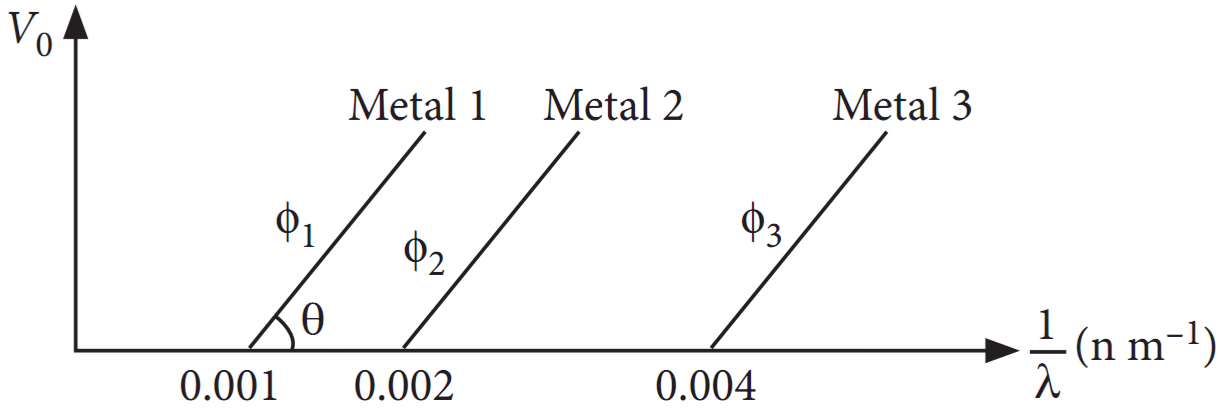
  1. The graph between the stopping potential (V0) and $\Big(\frac{1}{\lambda}\Big)$ is shown in the figure. $\phi_1,\phi_2,\phi_3$ are work function. Which of the following options is correct?

  1. $\phi_1:\phi_2:\phi_3=1:2:3$

  2. $\phi_1:\phi_2:\phi_3=4:2:1$

  3. $\phi_1:\phi_2:\phi_3=1:2:4$

  4. Ultraviolet tight can be used to emit photoelectrons from metal 2 and metal 3 only.
  1. Which of the following figures represent the variation of particle momentum and the associated de-Broglie wavelength?

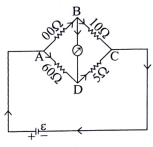
As shown in figure, resistances are connected in the four arms of a Wheatstone bridge.
Image

A galvanometer of $15 \Omega$ resistance is connected across BD. Calculate the current through galvanometer when a potential difference of 10 V is maintained across AC.
When subatomic particles undergo reactions, energy is conserved, but mass is not necessarily conserved. However, a particle's mass “contributes” to its total energy, in accordance with Einstein's famous equation, E = mc2 In this equation, E denotes the energy carried by a particle because of its mass. The particle can also have additional energy due to its motion and its interactions with other particles. Consider a neutron at rest and well separated from other particles. It decays into a proton, an electron and an undetected third particle as given here: Neutron → proton + electron + ???

The given table summarizes some data from a single neutron decay. Electron volt is a unit of energy. Column 2 shows the rest mass of the particle times the speed of light squared.

Particle
Mass × c2 (MeV)
Kinetic energy (MeV)
Neutron
940.97
0.00
Proton
939.67
0.01
Electron
0.51
0.39
  1. From the given table, which properties of the undetected third particle can be calculate?
  1. Total energy, but not kinetic energy.
  2. Kinetic energy, but not total energy.
  3. Both total energy and kinetic energy.
  4. Neither total energy nor kinetic energy.
  1. Assuming the table contains no major errors, what can we conclude about the (mass × c2) of the undetected third particle?
  1. It is 0. 79 MeV
  2. It is 0.39 MeV
  3. It is less than or equal to 0.79 MeV; but we cannot be more precise.
  4. It is less than or equal to 0.40 MeV; but we cannot be more precise.
  1. Could this reaction occur?

Proton → neutron + other particles

  1. Yes, if the other particles have much more kinetic energy than mass energy.
  2. Yes, but only if the proton has potential energy (due to interactions with other particles). 
  3. No, because a neutron is more massive than a proton.
  4. No, because a proton is positively charged while a neutron is electrically neutral.
  1. How much mass has to be converted into energy to produce electric power of 500MW for one hour?
  1. 2 × 10-5kg
  2. 1 × 10⁻⁵kg
  3. 3 × 10⁻⁵kg
  4. 4 × 10⁻⁵kg
  1. The equivalent energy of 1g of substance is.
  1. 9 × 10¹³J
  2. 6 × 10¹²J
  3. 3 × 10¹³J
  4. 6 × 10¹³J