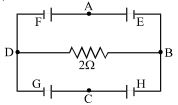
Calculate the net resistance of the circuit between $A$ and $B$
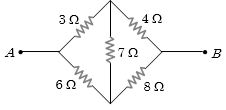
AIPMT 2000, Medium

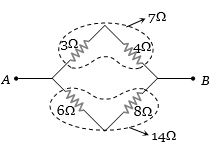

Download our appand get started for free
Experience the future of education. Simply download our apps or reach out to us for more information. Let's shape the future of learning together!No signup needed.*
Similar Questions
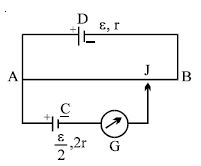
- 1In the figure, the potentiometer wire $AB$ of length $L$ and resistance $9r$ is joined to the cell $D$ of $\mathrm{emf}$ $\varepsilon$ and internal resistance $r$. The cell $C’s$ $\mathrm{emf}$ is $\varepsilon /2$ and its internal resistance is $2r$. The galvanometer $G$ will show no deflection when the length $AJ$ isView Solution
- 2What is the number density of donor atoms which must be added to a pure germanium semiconductor to make $n-$ type semiconductor of conductivity $6.4\ {\Omega ^{ - 1}}\,c{m^{ - 1}}$? The mobility of electr ons in $n-$ type germanium is $4 \times {10^3}\ cm^2\ V^{-1}\ s^{-1}$. Neglect the contribution of holes to conductivityView Solution
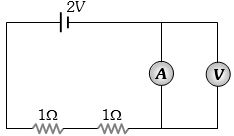
- 3In the circuit shown, $A$ and $V$ are ideal ammeter and voltmeter respectively. Reading of the voltmeter will be ............... $V$View Solution
- 4In the circuit shown $E, F, G$ and $H$ are cells of $\mathrm{e.m.f.}$ $2\,V, 1\,V, 3\,V$ and $1\,V$ respectively and their internal resistances are $2\,\Omega , 1\,\Omega , 3\,\Omega$ and $1\,\Omega$ respectively.View Solution
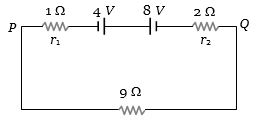
- 5Two batteries of $e.m.f.$ $4\,V$ and $8 \,V$ with internal resistances $1\, \Omega$ and $2\,\Omega$ are connected in a circuit with a resistance of $9 \,\Omega$ as shown in figure. The current and potential difference between the points $P$ and $Q$ areView Solution
- 6In a potentiometer circuit a cell of $EMF$ $1.5\, {V}$ gives balance point at $36\, {cm}$ length of wire. If another cell of $EMF$ $2.5\, {V}$ replaces the first cell, then at what length of the wire, the balance point occurs ? (in $cm$)View Solution
- 7The current density is a solid cylindrical wire of radius $R ,$ as a function of radial distance $r$ is given by $J ( r )= J _{0}\left(1-\frac{ r }{ R }\right) .$ The total current in the radial region $r =0$ to $r =\frac{ R }{4}$ will beView Solution
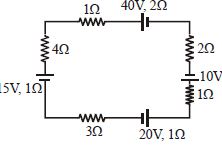
- 8View SolutionFind the current in the loop.
- 9A wire of length $5\,m$ and radius $1\,mm$ has a resistance of $1\, ohm$. What length of the wire of the same material at the same temperature and of radius $2\,mm$ will also have a resistance of $1\, ohm$ .............. $m$View Solution
- 10In a neon discharge tube $2.9 \times {10^{18}}\,N{e^ + }$ ions move to the right each second while $1.2 \times {10^{18}}$ electrons move to the left per second. Electron charge is $1.6 \times {10^{ - 19}}\,C$. The current in the discharge tubeView Solution