MCQ
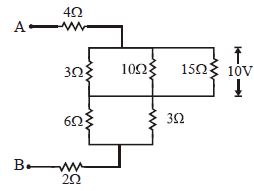
Calculate the potential difference between, points $A$ and $B$ and current flowing in $10\,\Omega $ resistor in the part of network below
  • A
    $20 \,V, 2\, A$
  • B
    $50 \,V, 1 \,A$
  • C
    $40\, V, 1\, A$
  • D
    $30\, V, 1\, A$

Answer

Need a full question paper?

Generate a complete, print-ready paper with questions like this in minutes — across 16+ boards, with answer keys.
Start Generating Free

Similar questions

A particle of mass $m$ and charge $q$ is thrown in a region where uniform gravitational field and electric field are present. The path of particle
Two polaroid sheets are placed one over the other with their axes inclined to each other at $30^{\circ}$. The ratio of the intensity of the unpolarised incident light and the polarised emergent light is 
According to Bohr’s theory of $H$ atom, an electron can revolve around a proton indefinitely, if its path is:
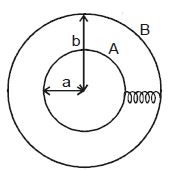
Two spherical conductors $A$ and $B$ of radii $a$ and $b$ $(b > a)$ are placed concentrically in air. The two are connected by a copper wire as shown in figure. Then the equivalent capacitance of the system is
In a double slit experiment, instead of taking slits of equal widths, one slit is made twice as wide as the other. Then in the interference pattern
A diode detector is used to detect and amplitude modulated wave of $60 \%$ modulation by using a condenser of capacity $250\, pF$ in parallel with a load resistance $100\, k \Omega$. Find the maximum modulated frequency which could be detected by it,
The coefficient of self induction of a coil is given by.
If the shift of wavelength of light emitted by a star is towards violet, then this shows that star is
Assume that a neutron breaks into a proton and an electron. The energy released during this process is :............$MeV$ (mass of neutron $= 1.6725 \times 10^{-27}$ $kg$ mass of proton $= 1.6725 \times 10^{-27} $ $kg$ mass of electron = $9 \times 10^{-31} $ $kg$)
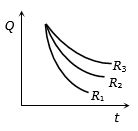
Three identical capacitors are given a charge $Q$ each and they are then allowed to discharge through resistance $R_1, R_2\,$ and $\,R_3$. Their charges, as a function of time shown in the graph below. The smallest of the three resistance is